AICP Budget Format: The Complete Guide for Commercial Producers (2026)

Feb 21, 2026

The AICP format is the standard budgeting and bidding structure used in commercial film production across the United States. If you are producing television commercials, music videos, branded content, or advertising campaigns, the AICP format is how agencies, production companies, and clients speak the same financial language.

This guide explains what AICP format is, how the account code structure works, who uses it, and how to build a compliant budget from scratch.

What Is AICP?

AICP stands for the Association of Independent Commercial Producers, the trade organization that represents production companies in the advertising industry. Founded in 1972, AICP established a standardized bid form and budget structure that became the industry norm for commercial production bidding and budgeting.

When producers or clients refer to "AICP format," they mean the standardized cost structure defined by this organization, not simply any budget for a commercial. Using AICP format signals that your production operates according to industry-recognized standards, which matters when submitting bids to advertising agencies, brand clients, and broadcast networks.

Why AICP Format Exists

Before AICP standardized the bid form in 1975, commercial production budgets were inconsistent. Agencies receiving bids from multiple production companies had no reliable way to compare them: one company might include crew costs in one section, another in a different section. Directors' fees might be buried in overhead by one bidder and called out separately by another.

The standardized AICP bid form solved this by giving everyone the same categories in the same order. An agency reviewing three competing bids for a national television spot can compare line by line because every production company uses the same structure.

The same logic applies when you're managing your own production budget against actuals. AICP format gives your production accountant, your line producer, and your client a shared framework for tracking where money is going.

AICP Budget Structure: How the Account Codes Work

The AICP bid form organizes production costs into sections using letter-prefixed account codes. Each section groups related costs, and each line item within a section gets a specific code. Here is the standard AICP section structure:

A: Pre-Production and Wrap

Pre-production costs cover everything that happens before the camera rolls. This includes:

  • Director fees (pre-production days, shoot days, post days)

  • Producer and production manager fees

  • Creative development and treatment fees

  • Location scouting and scout fees

  • Pre-light and pre-rig days

  • Casting and auditions

Wrap covers the production office closeout after the shoot: final crew payments, equipment returns, and administrative close-out costs.

B: Shooting Crew Labor

All on-set crew labor goes in section B, including:

  • Director of Photography

  • Camera operators and assistants

  • Gaffer, best boy electric, electricians

  • Key grip, dolly grip, grips

  • Sound mixer and boom operator

  • Art director, set decorator, props

  • Hair, makeup, wardrobe

  • Production assistants and runners

Each crew member is listed with their daily or weekly rate, the number of days, and any applicable overtime or turnaround adjustments.

C: Location and Travel

Section C covers all costs related to where you shoot:

  • Location fees and permits

  • Set construction (if built on location)

  • Catering and craft services

  • Transportation: picture cars, production vans, camera trucks

  • Hotel and per diem for out-of-town crew

  • Air travel

D: Props, Wardrobe, and Animals

Section D captures costs for everything that appears on screen but is not part of the crew or location:

  • Prop fabrication and purchase

  • Wardrobe styling and purchase

  • Animal trainers, wranglers, and the animals themselves

  • Picture vehicles (cars, trucks, motorcycles featured in the spot)

E: Studio and Stages

If you are shooting on a soundstage or in a studio facility, these costs go in section E:

  • Stage rental by day

  • Power and utilities

  • Stage equipment (included or additional)

  • Green room and dressing rooms

  • Expendables and production supplies

F: Equipment

Camera, lighting, and grip equipment rentals all appear in section F:

  • Camera package (body, lenses, accessories)

  • Lighting package

  • Grip package (stands, flags, diffusion)

  • Sound equipment

  • Specialty equipment (cranes, drones, steadicam)

  • Generators

G: Videotape and Lab

Digital media and data management costs fall in section G:

  • Digital media cards and drives

  • Data management and digital loader fees

  • Digital dailies

  • Archiving and backup

P: Post-Production

The P sections cover everything that happens after the shoot wraps. Unlike the A through G sections, there can be multiple P sections in an AICP bid. Modern AICP bid forms allow customizable P sections (P1, P2, P3, etc.) to reflect the specifics of each project's post workflow:

  • Editorial (editing suite, editor, assistant editor)

  • Color grading and finishing

  • VFX and motion graphics

  • Audio mix and sound design

  • Music licensing or composition

  • Deliverables and file distribution

ATL vs. BTL in AICP Budgets

AICP budgets use the same Above-the-Line (ATL) and Below-the-Line (BTL) distinction found in feature film budgeting, but the categories are defined differently in commercial production.

In commercial production, ATL typically refers to creative and directorial talent: the director, the director of photography, creative development costs, and sometimes the producer. BTL covers all production execution costs: crew, equipment, locations, props, and post-production.

This distinction matters for how agencies and clients evaluate bids. A director's fee sits above the line because it is largely non-negotiable once talent is attached. BTL costs are where production companies can show efficiency and value.

For a full explanation of how ATL and BTL work across all production formats, see our guide to how to create a film budget.

Production Fee and Markup

One of the most important line items in an AICP budget is the production company markup, sometimes called the production fee or overhead. This is the production company's gross profit on the job, typically calculated as a percentage of hard costs (BTL costs excluding talent).

Industry standard production fee percentages vary, but ranges of 15-35% on hard costs are common depending on the size of the job, the relationship with the agency, and the competitive bidding situation. The production fee is disclosed in the AICP bid and is therefore transparent to the client.

How the AICP Bid Form Works in Practice

When an advertising agency solicits bids for a commercial, they typically invite two or three production companies to bid on the same script. Each production company submits an AICP bid form showing their cost breakdown.

The agency uses the standardized format to compare:

  • Director and key talent costs

  • Crew day rates

  • Equipment package costs

  • Post-production approach and cost

  • Production fee percentage

A bid that comes in significantly higher than competitors needs to justify the difference: a more experienced director, a more elaborate set, a more comprehensive post workflow. The standardized format makes these comparisons straightforward.

Once the bid is awarded, the AICP budget becomes the working document for the production. Actual costs are tracked against the bid line by line, and any overages must be discussed with the agency before they are incurred.

AICP Format vs. Feature Film Budget Format

Producers moving between commercial production and narrative filmmaking encounter meaningful differences in budget format:

Element

AICP Commercial Format

Feature Film Format

Standard body

AICP (Association of Independent Commercial Producers)

DGA, IATSE, SAG-AFTRA agreements

Duration

Hours to days of principal photography

Weeks to months

ATL definition

Director, DP, creative costs

Producers, director, writer, principal cast

Post structure

P sections (customizable)

Post-production section (accounts 5000+)

Overhead

Production fee (% of hard costs)

Overhead (% of below-the-line)

Client review

Bid form shared with agency/client

Budget typically internal or investor-facing

Commercial producers working in narrative for the first time, and narrative producers moving into commercial work, both need to learn the other format's conventions. The underlying financial logic is similar: account for every cost, track actuals against budget, manage cash flow carefully.

Who Uses AICP Format

AICP format is the standard for:

  • Television commercial production companies bidding on national and regional advertising campaigns

  • Music video production companies billing record labels and streaming platforms for video production

  • Branded content producers working on longer-form advertising content for brand clients

  • Digital and social content production companies producing ads for digital platforms and social media campaigns

  • Production accountants managing actuals against approved bids on commercial productions

If you are working in any of these contexts, understanding and using AICP format is not optional: agencies, clients, and your own accountants will expect it.

Building an AICP Budget in Saturation

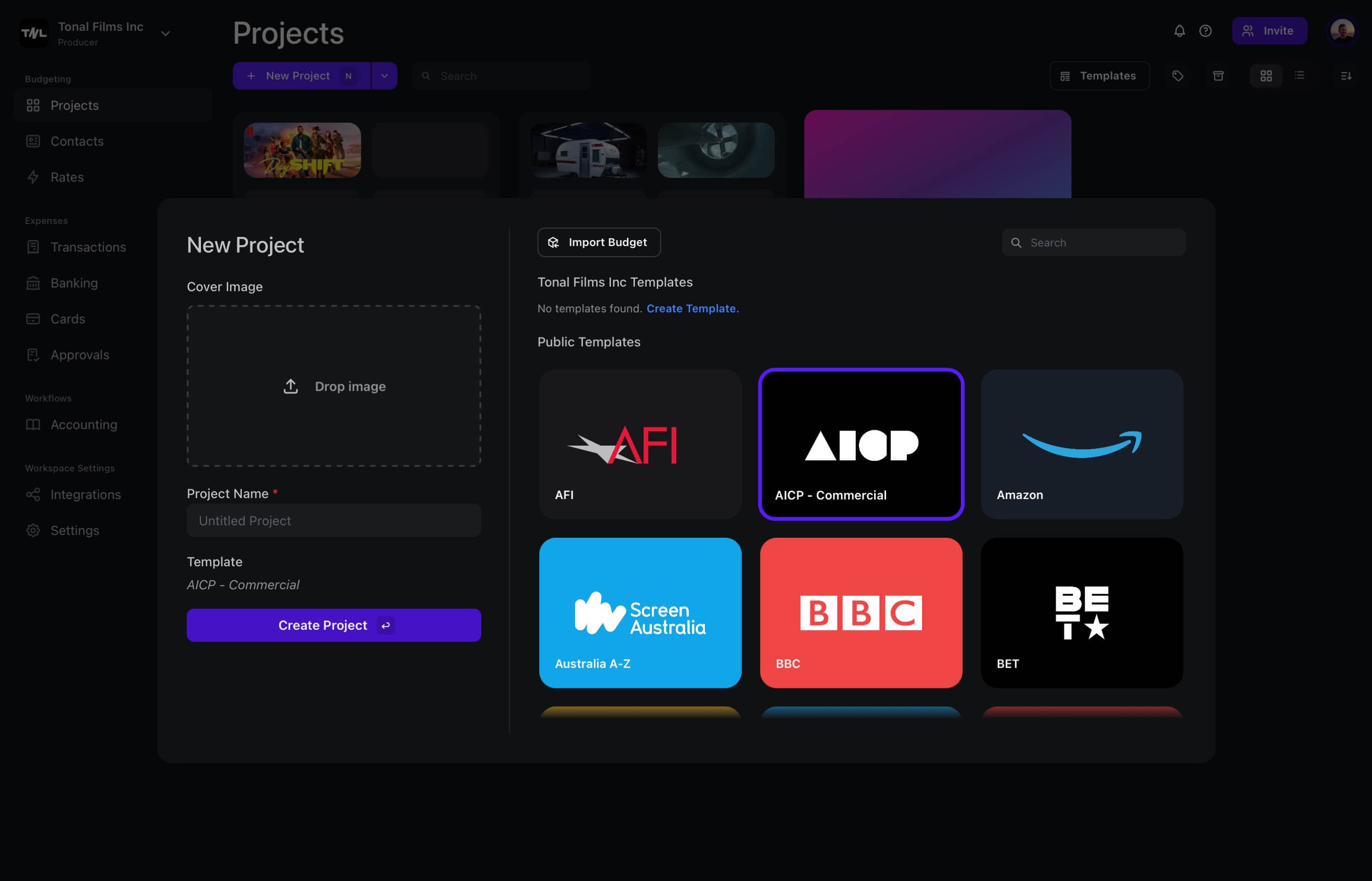
Saturation includes an AICP account code template specifically for commercial, music video, and branded content productions. The template pre-populates the standard AICP section structure (A through G plus P sections) so you are not building from scratch each time.

Within Saturation, you can:

  • Build your AICP bid using the standard account codes

  • Add director and DP rates, crew rates, and equipment costs to the appropriate sections

  • Calculate fringes automatically on applicable crew labor

  • Track actuals against the bid as the production progresses

  • Generate cost reports that show where you are against budget

  • Manage contractor payments through Saturation Pay for applicable vendors and crew

For a walkthrough of how to track production expenses against your AICP budget, see our guide to managing film production expenses.

AICP Chart of Accounts

Within each lettered section of the AICP format, individual line items are identified by account codes. These codes provide a granular breakdown within each category. For example, within section B (Shooting Crew Labor), you might see:

  • B01: Director of Photography

  • B02: Operator

  • B03: First Camera Assistant

  • B04: Second Camera Assistant

  • B05: Gaffer

  • B06: Best Boy Electric

The chart of accounts provides the granularity needed for actual cost tracking, where you need to know not just that camera department came in over budget, but specifically which line items drove the variance. Production accounting software that supports AICP format, including Saturation, maps your budget entries to these account codes automatically.

For a broader look at how production accounting works across both commercial and narrative formats, see our guide to film production accounting software.

Fringe Calculations in AICP Budgets

One of the more complex elements of any production budget is fringe benefits: employer-side taxes and contributions applied to labor costs. For AICP commercial productions, fringes typically include:

  • Payroll taxes: federal and state unemployment, FICA (Social Security and Medicare)

  • Union benefits: contributions to IATSE, SAG-AFTRA, and DGA health and pension plans when applicable

  • Workers compensation insurance (percentage of gross payroll)

  • General liability insurance (sometimes included, sometimes separate)

Fringe rates in commercial production can add 20-35% or more to base labor costs depending on union affiliation, state, and the specific crew classification. Accurately calculating fringes before the shoot is essential for submitting a competitive but profitable bid.

Saturation calculates fringes automatically against applicable labor lines in your AICP budget, reducing the risk of under-budgeting labor costs and delivering an unpleasant surprise during production accounting reconciliation.

Frequently Asked Questions

What does AICP stand for in film production?

AICP stands for the Association of Independent Commercial Producers, the U.S. trade organization representing production companies in the advertising industry. In production contexts, "AICP format" refers to the standardized bid form and budget structure this organization developed and maintains for commercial production bidding.

What is an AICP bid form?

The AICP bid form is a standardized budget document used when production companies submit cost proposals to advertising agencies for commercial projects. It organizes production costs into standardized sections (A through G plus P for post-production) so agencies can compare bids from multiple production companies on an apples-to-apples basis. The original AICP Bid Form was introduced in 1975.

Is AICP format only for commercials?

AICP format is the standard for television commercial production in the United States. It is also widely used for music videos and branded content because the production structure (shoot crew, locations, equipment, post) is similar. Narrative feature films and television series use different budget formats, though the ATL/BTL distinction applies across all formats.

What is the difference between the AICP bid form and a production budget?

The AICP bid form is the document submitted to the agency or client showing estimated costs before production. The production budget is the internal working document used to manage actual costs during production. In practice they often refer to the same document at different stages: the bid becomes the budget once the job is awarded, and actual costs are tracked against the original bid line items.

How are fringes calculated in an AICP budget?

Fringe benefits in an AICP commercial budget include payroll taxes (FICA, federal and state unemployment), union health and pension contributions (when applicable for IATSE, SAG-AFTRA, or DGA crew), and workers compensation insurance. Combined fringe rates of 20-35% on eligible labor are common, though the exact rate depends on state, union status, and the specific crew classifications. Budgeting software like Saturation automates fringe calculations against each labor line.

What is a production fee in an AICP budget?

The production fee is the production company's markup on hard costs, representing their gross profit on the job. It is typically calculated as a percentage of below-the-line costs and is disclosed in the AICP bid. Standard production fee percentages range from 15-35% depending on the size of the job and the competitive bidding environment. The fee is the production company's compensation for organizing and managing the production, beyond the direct costs of making it.

Can I use Saturation for AICP commercial budgeting?

Yes. Saturation includes an AICP account code template that pre-populates the standard AICP section structure for commercial, music video, and branded content productions. You can build your bid, track actuals against it during production, calculate fringes automatically, and manage contractor payments, all within the same platform. Start free at saturation.io.

The AICP format is the standard budgeting and bidding structure used in commercial film production across the United States. If you are producing television commercials, music videos, branded content, or advertising campaigns, the AICP format is how agencies, production companies, and clients speak the same financial language.

This guide explains what AICP format is, how the account code structure works, who uses it, and how to build a compliant budget from scratch.

What Is AICP?

AICP stands for the Association of Independent Commercial Producers, the trade organization that represents production companies in the advertising industry. Founded in 1972, AICP established a standardized bid form and budget structure that became the industry norm for commercial production bidding and budgeting.

When producers or clients refer to "AICP format," they mean the standardized cost structure defined by this organization, not simply any budget for a commercial. Using AICP format signals that your production operates according to industry-recognized standards, which matters when submitting bids to advertising agencies, brand clients, and broadcast networks.

Why AICP Format Exists

Before AICP standardized the bid form in 1975, commercial production budgets were inconsistent. Agencies receiving bids from multiple production companies had no reliable way to compare them: one company might include crew costs in one section, another in a different section. Directors' fees might be buried in overhead by one bidder and called out separately by another.

The standardized AICP bid form solved this by giving everyone the same categories in the same order. An agency reviewing three competing bids for a national television spot can compare line by line because every production company uses the same structure.

The same logic applies when you're managing your own production budget against actuals. AICP format gives your production accountant, your line producer, and your client a shared framework for tracking where money is going.

AICP Budget Structure: How the Account Codes Work

The AICP bid form organizes production costs into sections using letter-prefixed account codes. Each section groups related costs, and each line item within a section gets a specific code. Here is the standard AICP section structure:

A: Pre-Production and Wrap

Pre-production costs cover everything that happens before the camera rolls. This includes:

  • Director fees (pre-production days, shoot days, post days)

  • Producer and production manager fees

  • Creative development and treatment fees

  • Location scouting and scout fees

  • Pre-light and pre-rig days

  • Casting and auditions

Wrap covers the production office closeout after the shoot: final crew payments, equipment returns, and administrative close-out costs.

B: Shooting Crew Labor

All on-set crew labor goes in section B, including:

  • Director of Photography

  • Camera operators and assistants

  • Gaffer, best boy electric, electricians

  • Key grip, dolly grip, grips

  • Sound mixer and boom operator

  • Art director, set decorator, props

  • Hair, makeup, wardrobe

  • Production assistants and runners

Each crew member is listed with their daily or weekly rate, the number of days, and any applicable overtime or turnaround adjustments.

C: Location and Travel

Section C covers all costs related to where you shoot:

  • Location fees and permits

  • Set construction (if built on location)

  • Catering and craft services

  • Transportation: picture cars, production vans, camera trucks

  • Hotel and per diem for out-of-town crew

  • Air travel

D: Props, Wardrobe, and Animals

Section D captures costs for everything that appears on screen but is not part of the crew or location:

  • Prop fabrication and purchase

  • Wardrobe styling and purchase

  • Animal trainers, wranglers, and the animals themselves

  • Picture vehicles (cars, trucks, motorcycles featured in the spot)

E: Studio and Stages

If you are shooting on a soundstage or in a studio facility, these costs go in section E:

  • Stage rental by day

  • Power and utilities

  • Stage equipment (included or additional)

  • Green room and dressing rooms

  • Expendables and production supplies

F: Equipment

Camera, lighting, and grip equipment rentals all appear in section F:

  • Camera package (body, lenses, accessories)

  • Lighting package

  • Grip package (stands, flags, diffusion)

  • Sound equipment

  • Specialty equipment (cranes, drones, steadicam)

  • Generators

G: Videotape and Lab

Digital media and data management costs fall in section G:

  • Digital media cards and drives

  • Data management and digital loader fees

  • Digital dailies

  • Archiving and backup

P: Post-Production

The P sections cover everything that happens after the shoot wraps. Unlike the A through G sections, there can be multiple P sections in an AICP bid. Modern AICP bid forms allow customizable P sections (P1, P2, P3, etc.) to reflect the specifics of each project's post workflow:

  • Editorial (editing suite, editor, assistant editor)

  • Color grading and finishing

  • VFX and motion graphics

  • Audio mix and sound design

  • Music licensing or composition

  • Deliverables and file distribution

ATL vs. BTL in AICP Budgets

AICP budgets use the same Above-the-Line (ATL) and Below-the-Line (BTL) distinction found in feature film budgeting, but the categories are defined differently in commercial production.

In commercial production, ATL typically refers to creative and directorial talent: the director, the director of photography, creative development costs, and sometimes the producer. BTL covers all production execution costs: crew, equipment, locations, props, and post-production.

This distinction matters for how agencies and clients evaluate bids. A director's fee sits above the line because it is largely non-negotiable once talent is attached. BTL costs are where production companies can show efficiency and value.

For a full explanation of how ATL and BTL work across all production formats, see our guide to how to create a film budget.

Production Fee and Markup

One of the most important line items in an AICP budget is the production company markup, sometimes called the production fee or overhead. This is the production company's gross profit on the job, typically calculated as a percentage of hard costs (BTL costs excluding talent).

Industry standard production fee percentages vary, but ranges of 15-35% on hard costs are common depending on the size of the job, the relationship with the agency, and the competitive bidding situation. The production fee is disclosed in the AICP bid and is therefore transparent to the client.

How the AICP Bid Form Works in Practice

When an advertising agency solicits bids for a commercial, they typically invite two or three production companies to bid on the same script. Each production company submits an AICP bid form showing their cost breakdown.

The agency uses the standardized format to compare:

  • Director and key talent costs

  • Crew day rates

  • Equipment package costs

  • Post-production approach and cost

  • Production fee percentage

A bid that comes in significantly higher than competitors needs to justify the difference: a more experienced director, a more elaborate set, a more comprehensive post workflow. The standardized format makes these comparisons straightforward.

Once the bid is awarded, the AICP budget becomes the working document for the production. Actual costs are tracked against the bid line by line, and any overages must be discussed with the agency before they are incurred.

AICP Format vs. Feature Film Budget Format

Producers moving between commercial production and narrative filmmaking encounter meaningful differences in budget format:

Element

AICP Commercial Format

Feature Film Format

Standard body

AICP (Association of Independent Commercial Producers)

DGA, IATSE, SAG-AFTRA agreements

Duration

Hours to days of principal photography

Weeks to months

ATL definition

Director, DP, creative costs

Producers, director, writer, principal cast

Post structure

P sections (customizable)

Post-production section (accounts 5000+)

Overhead

Production fee (% of hard costs)

Overhead (% of below-the-line)

Client review

Bid form shared with agency/client

Budget typically internal or investor-facing

Commercial producers working in narrative for the first time, and narrative producers moving into commercial work, both need to learn the other format's conventions. The underlying financial logic is similar: account for every cost, track actuals against budget, manage cash flow carefully.

Who Uses AICP Format

AICP format is the standard for:

  • Television commercial production companies bidding on national and regional advertising campaigns

  • Music video production companies billing record labels and streaming platforms for video production

  • Branded content producers working on longer-form advertising content for brand clients

  • Digital and social content production companies producing ads for digital platforms and social media campaigns

  • Production accountants managing actuals against approved bids on commercial productions

If you are working in any of these contexts, understanding and using AICP format is not optional: agencies, clients, and your own accountants will expect it.

Building an AICP Budget in Saturation

Saturation includes an AICP account code template specifically for commercial, music video, and branded content productions. The template pre-populates the standard AICP section structure (A through G plus P sections) so you are not building from scratch each time.

Within Saturation, you can:

  • Build your AICP bid using the standard account codes

  • Add director and DP rates, crew rates, and equipment costs to the appropriate sections

  • Calculate fringes automatically on applicable crew labor

  • Track actuals against the bid as the production progresses

  • Generate cost reports that show where you are against budget

  • Manage contractor payments through Saturation Pay for applicable vendors and crew

For a walkthrough of how to track production expenses against your AICP budget, see our guide to managing film production expenses.

AICP Chart of Accounts

Within each lettered section of the AICP format, individual line items are identified by account codes. These codes provide a granular breakdown within each category. For example, within section B (Shooting Crew Labor), you might see:

  • B01: Director of Photography

  • B02: Operator

  • B03: First Camera Assistant

  • B04: Second Camera Assistant

  • B05: Gaffer

  • B06: Best Boy Electric

The chart of accounts provides the granularity needed for actual cost tracking, where you need to know not just that camera department came in over budget, but specifically which line items drove the variance. Production accounting software that supports AICP format, including Saturation, maps your budget entries to these account codes automatically.

For a broader look at how production accounting works across both commercial and narrative formats, see our guide to film production accounting software.

Fringe Calculations in AICP Budgets

One of the more complex elements of any production budget is fringe benefits: employer-side taxes and contributions applied to labor costs. For AICP commercial productions, fringes typically include:

  • Payroll taxes: federal and state unemployment, FICA (Social Security and Medicare)

  • Union benefits: contributions to IATSE, SAG-AFTRA, and DGA health and pension plans when applicable

  • Workers compensation insurance (percentage of gross payroll)

  • General liability insurance (sometimes included, sometimes separate)

Fringe rates in commercial production can add 20-35% or more to base labor costs depending on union affiliation, state, and the specific crew classification. Accurately calculating fringes before the shoot is essential for submitting a competitive but profitable bid.

Saturation calculates fringes automatically against applicable labor lines in your AICP budget, reducing the risk of under-budgeting labor costs and delivering an unpleasant surprise during production accounting reconciliation.

Frequently Asked Questions

What does AICP stand for in film production?

AICP stands for the Association of Independent Commercial Producers, the U.S. trade organization representing production companies in the advertising industry. In production contexts, "AICP format" refers to the standardized bid form and budget structure this organization developed and maintains for commercial production bidding.

What is an AICP bid form?

The AICP bid form is a standardized budget document used when production companies submit cost proposals to advertising agencies for commercial projects. It organizes production costs into standardized sections (A through G plus P for post-production) so agencies can compare bids from multiple production companies on an apples-to-apples basis. The original AICP Bid Form was introduced in 1975.

Is AICP format only for commercials?

AICP format is the standard for television commercial production in the United States. It is also widely used for music videos and branded content because the production structure (shoot crew, locations, equipment, post) is similar. Narrative feature films and television series use different budget formats, though the ATL/BTL distinction applies across all formats.

What is the difference between the AICP bid form and a production budget?

The AICP bid form is the document submitted to the agency or client showing estimated costs before production. The production budget is the internal working document used to manage actual costs during production. In practice they often refer to the same document at different stages: the bid becomes the budget once the job is awarded, and actual costs are tracked against the original bid line items.

How are fringes calculated in an AICP budget?

Fringe benefits in an AICP commercial budget include payroll taxes (FICA, federal and state unemployment), union health and pension contributions (when applicable for IATSE, SAG-AFTRA, or DGA crew), and workers compensation insurance. Combined fringe rates of 20-35% on eligible labor are common, though the exact rate depends on state, union status, and the specific crew classifications. Budgeting software like Saturation automates fringe calculations against each labor line.

What is a production fee in an AICP budget?

The production fee is the production company's markup on hard costs, representing their gross profit on the job. It is typically calculated as a percentage of below-the-line costs and is disclosed in the AICP bid. Standard production fee percentages range from 15-35% depending on the size of the job and the competitive bidding environment. The fee is the production company's compensation for organizing and managing the production, beyond the direct costs of making it.

Can I use Saturation for AICP commercial budgeting?

Yes. Saturation includes an AICP account code template that pre-populates the standard AICP section structure for commercial, music video, and branded content productions. You can build your bid, track actuals against it during production, calculate fringes automatically, and manage contractor payments, all within the same platform. Start free at saturation.io.

The AICP format is the standard budgeting and bidding structure used in commercial film production across the United States. If you are producing television commercials, music videos, branded content, or advertising campaigns, the AICP format is how agencies, production companies, and clients speak the same financial language.

This guide explains what AICP format is, how the account code structure works, who uses it, and how to build a compliant budget from scratch.

What Is AICP?

AICP stands for the Association of Independent Commercial Producers, the trade organization that represents production companies in the advertising industry. Founded in 1972, AICP established a standardized bid form and budget structure that became the industry norm for commercial production bidding and budgeting.

When producers or clients refer to "AICP format," they mean the standardized cost structure defined by this organization, not simply any budget for a commercial. Using AICP format signals that your production operates according to industry-recognized standards, which matters when submitting bids to advertising agencies, brand clients, and broadcast networks.

Why AICP Format Exists

Before AICP standardized the bid form in 1975, commercial production budgets were inconsistent. Agencies receiving bids from multiple production companies had no reliable way to compare them: one company might include crew costs in one section, another in a different section. Directors' fees might be buried in overhead by one bidder and called out separately by another.

The standardized AICP bid form solved this by giving everyone the same categories in the same order. An agency reviewing three competing bids for a national television spot can compare line by line because every production company uses the same structure.

The same logic applies when you're managing your own production budget against actuals. AICP format gives your production accountant, your line producer, and your client a shared framework for tracking where money is going.

AICP Budget Structure: How the Account Codes Work

The AICP bid form organizes production costs into sections using letter-prefixed account codes. Each section groups related costs, and each line item within a section gets a specific code. Here is the standard AICP section structure:

A: Pre-Production and Wrap

Pre-production costs cover everything that happens before the camera rolls. This includes:

  • Director fees (pre-production days, shoot days, post days)

  • Producer and production manager fees

  • Creative development and treatment fees

  • Location scouting and scout fees

  • Pre-light and pre-rig days

  • Casting and auditions

Wrap covers the production office closeout after the shoot: final crew payments, equipment returns, and administrative close-out costs.

B: Shooting Crew Labor

All on-set crew labor goes in section B, including:

  • Director of Photography

  • Camera operators and assistants

  • Gaffer, best boy electric, electricians

  • Key grip, dolly grip, grips

  • Sound mixer and boom operator

  • Art director, set decorator, props

  • Hair, makeup, wardrobe

  • Production assistants and runners

Each crew member is listed with their daily or weekly rate, the number of days, and any applicable overtime or turnaround adjustments.

C: Location and Travel

Section C covers all costs related to where you shoot:

  • Location fees and permits

  • Set construction (if built on location)

  • Catering and craft services

  • Transportation: picture cars, production vans, camera trucks

  • Hotel and per diem for out-of-town crew

  • Air travel

D: Props, Wardrobe, and Animals

Section D captures costs for everything that appears on screen but is not part of the crew or location:

  • Prop fabrication and purchase

  • Wardrobe styling and purchase

  • Animal trainers, wranglers, and the animals themselves

  • Picture vehicles (cars, trucks, motorcycles featured in the spot)

E: Studio and Stages

If you are shooting on a soundstage or in a studio facility, these costs go in section E:

  • Stage rental by day

  • Power and utilities

  • Stage equipment (included or additional)

  • Green room and dressing rooms

  • Expendables and production supplies

F: Equipment

Camera, lighting, and grip equipment rentals all appear in section F:

  • Camera package (body, lenses, accessories)

  • Lighting package

  • Grip package (stands, flags, diffusion)

  • Sound equipment

  • Specialty equipment (cranes, drones, steadicam)

  • Generators

G: Videotape and Lab

Digital media and data management costs fall in section G:

  • Digital media cards and drives

  • Data management and digital loader fees

  • Digital dailies

  • Archiving and backup

P: Post-Production

The P sections cover everything that happens after the shoot wraps. Unlike the A through G sections, there can be multiple P sections in an AICP bid. Modern AICP bid forms allow customizable P sections (P1, P2, P3, etc.) to reflect the specifics of each project's post workflow:

  • Editorial (editing suite, editor, assistant editor)

  • Color grading and finishing

  • VFX and motion graphics

  • Audio mix and sound design

  • Music licensing or composition

  • Deliverables and file distribution

ATL vs. BTL in AICP Budgets

AICP budgets use the same Above-the-Line (ATL) and Below-the-Line (BTL) distinction found in feature film budgeting, but the categories are defined differently in commercial production.

In commercial production, ATL typically refers to creative and directorial talent: the director, the director of photography, creative development costs, and sometimes the producer. BTL covers all production execution costs: crew, equipment, locations, props, and post-production.

This distinction matters for how agencies and clients evaluate bids. A director's fee sits above the line because it is largely non-negotiable once talent is attached. BTL costs are where production companies can show efficiency and value.

For a full explanation of how ATL and BTL work across all production formats, see our guide to how to create a film budget.

Production Fee and Markup

One of the most important line items in an AICP budget is the production company markup, sometimes called the production fee or overhead. This is the production company's gross profit on the job, typically calculated as a percentage of hard costs (BTL costs excluding talent).

Industry standard production fee percentages vary, but ranges of 15-35% on hard costs are common depending on the size of the job, the relationship with the agency, and the competitive bidding situation. The production fee is disclosed in the AICP bid and is therefore transparent to the client.

How the AICP Bid Form Works in Practice

When an advertising agency solicits bids for a commercial, they typically invite two or three production companies to bid on the same script. Each production company submits an AICP bid form showing their cost breakdown.

The agency uses the standardized format to compare:

  • Director and key talent costs

  • Crew day rates

  • Equipment package costs

  • Post-production approach and cost

  • Production fee percentage

A bid that comes in significantly higher than competitors needs to justify the difference: a more experienced director, a more elaborate set, a more comprehensive post workflow. The standardized format makes these comparisons straightforward.

Once the bid is awarded, the AICP budget becomes the working document for the production. Actual costs are tracked against the bid line by line, and any overages must be discussed with the agency before they are incurred.

AICP Format vs. Feature Film Budget Format

Producers moving between commercial production and narrative filmmaking encounter meaningful differences in budget format:

Element

AICP Commercial Format

Feature Film Format

Standard body

AICP (Association of Independent Commercial Producers)

DGA, IATSE, SAG-AFTRA agreements

Duration

Hours to days of principal photography

Weeks to months

ATL definition

Director, DP, creative costs

Producers, director, writer, principal cast

Post structure

P sections (customizable)

Post-production section (accounts 5000+)

Overhead

Production fee (% of hard costs)

Overhead (% of below-the-line)

Client review

Bid form shared with agency/client

Budget typically internal or investor-facing

Commercial producers working in narrative for the first time, and narrative producers moving into commercial work, both need to learn the other format's conventions. The underlying financial logic is similar: account for every cost, track actuals against budget, manage cash flow carefully.

Who Uses AICP Format

AICP format is the standard for:

  • Television commercial production companies bidding on national and regional advertising campaigns

  • Music video production companies billing record labels and streaming platforms for video production

  • Branded content producers working on longer-form advertising content for brand clients

  • Digital and social content production companies producing ads for digital platforms and social media campaigns

  • Production accountants managing actuals against approved bids on commercial productions

If you are working in any of these contexts, understanding and using AICP format is not optional: agencies, clients, and your own accountants will expect it.

Building an AICP Budget in Saturation

Saturation includes an AICP account code template specifically for commercial, music video, and branded content productions. The template pre-populates the standard AICP section structure (A through G plus P sections) so you are not building from scratch each time.

Within Saturation, you can:

  • Build your AICP bid using the standard account codes

  • Add director and DP rates, crew rates, and equipment costs to the appropriate sections

  • Calculate fringes automatically on applicable crew labor

  • Track actuals against the bid as the production progresses

  • Generate cost reports that show where you are against budget

  • Manage contractor payments through Saturation Pay for applicable vendors and crew

For a walkthrough of how to track production expenses against your AICP budget, see our guide to managing film production expenses.

AICP Chart of Accounts

Within each lettered section of the AICP format, individual line items are identified by account codes. These codes provide a granular breakdown within each category. For example, within section B (Shooting Crew Labor), you might see:

  • B01: Director of Photography

  • B02: Operator

  • B03: First Camera Assistant

  • B04: Second Camera Assistant

  • B05: Gaffer

  • B06: Best Boy Electric

The chart of accounts provides the granularity needed for actual cost tracking, where you need to know not just that camera department came in over budget, but specifically which line items drove the variance. Production accounting software that supports AICP format, including Saturation, maps your budget entries to these account codes automatically.

For a broader look at how production accounting works across both commercial and narrative formats, see our guide to film production accounting software.

Fringe Calculations in AICP Budgets

One of the more complex elements of any production budget is fringe benefits: employer-side taxes and contributions applied to labor costs. For AICP commercial productions, fringes typically include:

  • Payroll taxes: federal and state unemployment, FICA (Social Security and Medicare)

  • Union benefits: contributions to IATSE, SAG-AFTRA, and DGA health and pension plans when applicable

  • Workers compensation insurance (percentage of gross payroll)

  • General liability insurance (sometimes included, sometimes separate)

Fringe rates in commercial production can add 20-35% or more to base labor costs depending on union affiliation, state, and the specific crew classification. Accurately calculating fringes before the shoot is essential for submitting a competitive but profitable bid.

Saturation calculates fringes automatically against applicable labor lines in your AICP budget, reducing the risk of under-budgeting labor costs and delivering an unpleasant surprise during production accounting reconciliation.

Frequently Asked Questions

What does AICP stand for in film production?

AICP stands for the Association of Independent Commercial Producers, the U.S. trade organization representing production companies in the advertising industry. In production contexts, "AICP format" refers to the standardized bid form and budget structure this organization developed and maintains for commercial production bidding.

What is an AICP bid form?

The AICP bid form is a standardized budget document used when production companies submit cost proposals to advertising agencies for commercial projects. It organizes production costs into standardized sections (A through G plus P for post-production) so agencies can compare bids from multiple production companies on an apples-to-apples basis. The original AICP Bid Form was introduced in 1975.

Is AICP format only for commercials?

AICP format is the standard for television commercial production in the United States. It is also widely used for music videos and branded content because the production structure (shoot crew, locations, equipment, post) is similar. Narrative feature films and television series use different budget formats, though the ATL/BTL distinction applies across all formats.

What is the difference between the AICP bid form and a production budget?

The AICP bid form is the document submitted to the agency or client showing estimated costs before production. The production budget is the internal working document used to manage actual costs during production. In practice they often refer to the same document at different stages: the bid becomes the budget once the job is awarded, and actual costs are tracked against the original bid line items.

How are fringes calculated in an AICP budget?

Fringe benefits in an AICP commercial budget include payroll taxes (FICA, federal and state unemployment), union health and pension contributions (when applicable for IATSE, SAG-AFTRA, or DGA crew), and workers compensation insurance. Combined fringe rates of 20-35% on eligible labor are common, though the exact rate depends on state, union status, and the specific crew classifications. Budgeting software like Saturation automates fringe calculations against each labor line.

What is a production fee in an AICP budget?

The production fee is the production company's markup on hard costs, representing their gross profit on the job. It is typically calculated as a percentage of below-the-line costs and is disclosed in the AICP bid. Standard production fee percentages range from 15-35% depending on the size of the job and the competitive bidding environment. The fee is the production company's compensation for organizing and managing the production, beyond the direct costs of making it.

Can I use Saturation for AICP commercial budgeting?

Yes. Saturation includes an AICP account code template that pre-populates the standard AICP section structure for commercial, music video, and branded content productions. You can build your bid, track actuals against it during production, calculate fringes automatically, and manage contractor payments, all within the same platform. Start free at saturation.io.

Try Saturation today with our
free budget templates.

Get Free Template