Film Production Accounting Software: The Complete Guide (2026)

Feb 21, 2026

Film Production Accounting Software: The Complete Guide (2026)

By Jens Jacob, Film Producer (After Death, The Heart of Man), Co-Founder of Saturation.io

If you are a production accountant, line producer, or production manager, you already know that film production accounting software is not a nice-to-have. It is the operational backbone of every production. The right platform determines whether your cost reports are accurate, whether your purchase orders get approved on time, and whether the studio or bond company trusts your weekly actuals. The wrong platform means late nights correcting spreadsheet errors and chasing down paper receipts.

This guide covers everything you need to know about film production accounting software in 2026: what it does, how the major platforms compare, and how to choose the right tool for your production size and workflow.

What Is Film Production Accounting Software?

Film production accounting software is a specialized financial management platform built for the unique demands of the entertainment production industry. Unlike general-purpose accounting tools like QuickBooks or Xero, production accounting software is designed around the specific workflows of film and TV: budget codes, cost report formats, purchase orders, petty cash funds, accounts payable to vendors and crew, and payroll integration with union and non-union talent.

A production does not run like a regular business. It has a hard start date, a hard end date, a fixed budget, a department structure with separate cost centers, and legal obligations to guilds and unions. Generic accounting software cannot handle this complexity. Production accounting software is built to handle all of it in one place.

Core functions typically include:

  • Budget management and actuals tracking

  • Cost reporting (daily and weekly cost reports)

  • Accounts payable: vendor invoices, purchase orders, check requests

  • Petty cash fund management

  • Crew expense tracking

  • Payroll processing integration (union and non-union)

  • Bank reconciliation

  • General ledger and chart of accounts management

  • Financial reporting for studios, distributors, and bond companies

Budgeting Software vs. Accounting Software: A Critical Distinction

Many people in the industry conflate budgeting software with accounting software. They are related but fundamentally different tools that serve different phases and functions of a production.

Budgeting software is used in pre-production to build the initial budget. It organizes estimated costs by category, calculates fringe benefits on labor, and produces the budget document that gets approved before cameras roll. Tools like Movie Magic Budgeting are classic examples of pure budgeting software.

Accounting software is used throughout production and post to track actual spending against that budget. It handles invoices, purchase orders, payroll data, petty cash, and produces cost reports showing where money was actually spent versus what was budgeted.

The gap between these two tools has historically caused friction: data had to be manually re-entered from the budgeting system into the accounting system, creating errors and delays in cost reports.

The direction in 2026 is toward integrated platforms that handle both budgeting and accounting in one system, eliminating that manual handoff. Saturation is built around this integrated approach, combining collaborative budgeting with expense tracking and actuals management so your budget and actuals are always in the same place.

For a deeper look at the budgeting side of this workflow, see our guide to the best film budgeting software.

What Production Accountants Actually Need

Production accountants are not just bookkeepers. They are financial managers running the financial operation of a multi-million dollar temporary business. To do that job well, the software needs to support a specific set of workflows.

Cost Reports: DCRs and WCRs Explained

The cost report is the central deliverable of production accounting. There are two main types that every production accountant produces on a regular basis.

Daily Cost Reports (DCRs) track spending day by day during the shoot. They give producers and department heads real-time visibility into where money is going so they can course-correct before overspending compounds into a larger problem. A DCR typically includes that day's costs broken out by department and budget account code, running totals, and any flagged overages.

Weekly Cost Reports (WCRs) are the formal financial document submitted to the studio, network, or bond company at the end of each production week. A WCR shows: costs paid during the current week, costs paid to date, open purchase order commitments, total estimated final cost, and variance from the approved budget by account. This document is how studio executives, producers, and the bond company monitor whether the production will finish on budget. Bond companies use the WCR to determine whether to advance additional funds or intervene in a troubled production.

Good production accounting software generates both report types automatically from your actuals data. Manual cost report preparation in spreadsheets is a productivity drain and an error risk that modern platforms have largely eliminated.

Purchase Orders and Accounts Payable

Every vendor payment on a film production is preceded by a purchase order (PO). The PO commits a specific dollar amount from the budget to a specific vendor for a specific service, before the work is performed. When the vendor invoice arrives, it is matched against the open PO, approved through the production's approval workflow, and then paid.

Production accounting software manages this entire AP cycle: PO creation, approval routing, invoice matching, check issuance or ACH payment, and posting to the general ledger. A robust PO system gives the production accountant visibility into total committed costs, not just costs already paid. This is critical for accurate cost reporting because many costs are committed weeks before they are invoiced and paid.

Petty Cash Management

Every production runs petty cash funds across multiple departments simultaneously. The grip department buys expendables. The art department buys set dressing. The production office buys supplies. Each department head or petty cash custodian advances cash from the production accountant and submits receipts to account for how it was spent.

Managing multiple open petty cash funds manually is one of the most time-consuming tasks in production accounting. Good software tracks each fund by custodian, shows the current balance, lists outstanding envelopes not yet reconciled, and links submitted receipts to the correct budget account code.

Budget vs. Actuals

The core function of production accounting is comparing what was budgeted against what was actually spent. This requires that budget data and accounting data live in the same system, or integrate seamlessly between systems. When the two are separate, the comparison requires manual exports, reformatting, and cross-referencing that is slow and error-prone. The integrated platform approach solves this by design.

Payroll Data Integration

Payroll is the largest cost center on most productions. Production accountants need payroll data to post to the general ledger, update cost reports, and track labor costs by department and budget line. This requires either a built-in payroll function or a direct integration with the payroll service being used on the production.

Multi-User Collaboration

A production accounting department is a team. The production accountant, assistant accountants, payroll accountant, and department coordinators all need access to different parts of the system simultaneously, often from different locations. Cloud-based platforms enable this real-time collaboration in a way that desktop software installed on a single machine simply cannot match.

The Main Film Production Accounting Software Platforms in 2026
Here is an honest breakdown of the major platforms used by production accountants today.

Saturation

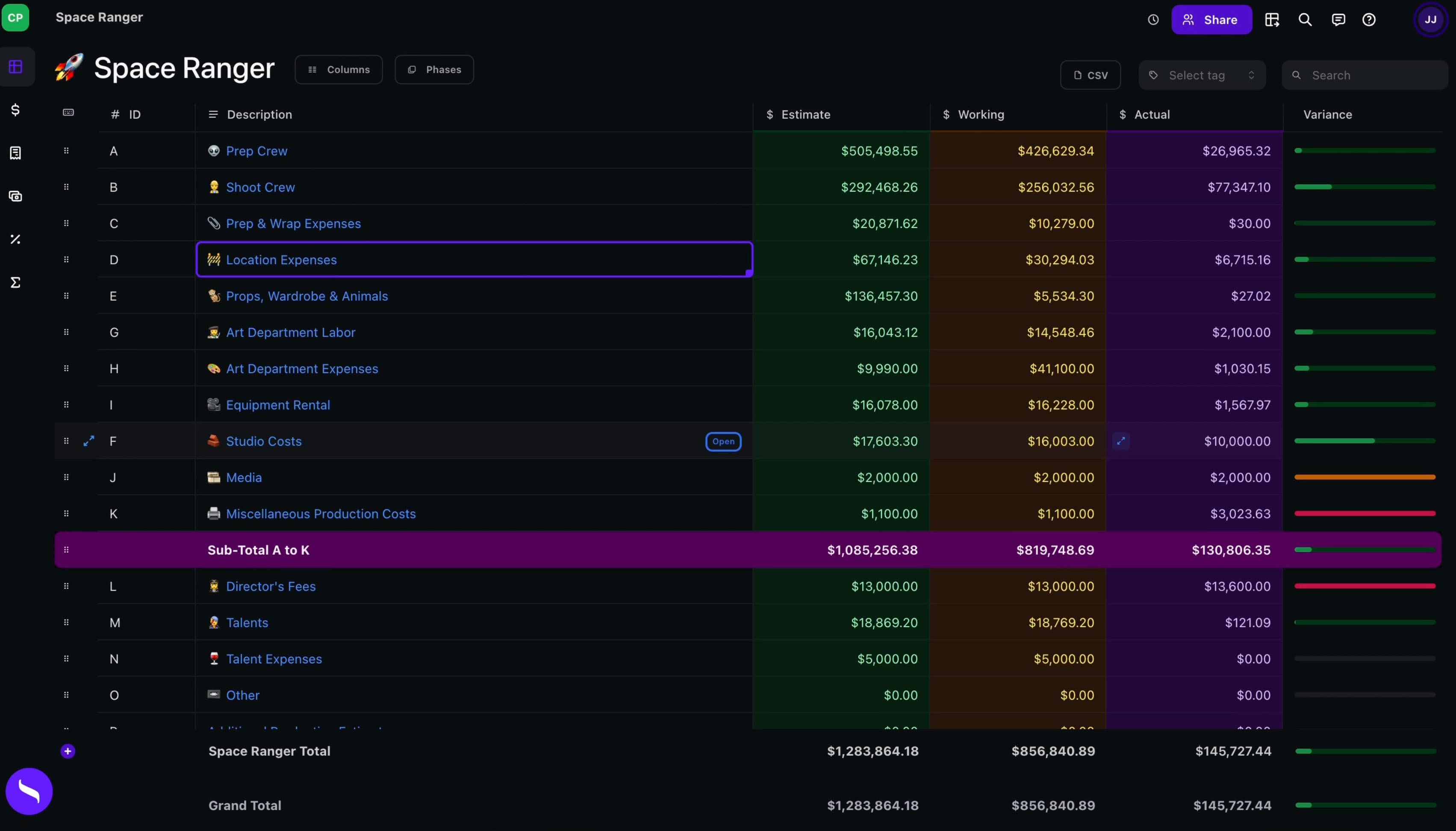
Saturation is a cloud-based financial management platform built for the production economy. It is designed to integrate budgeting, expense management, actuals tracking, and production banking in one place, eliminating the traditional handoffs between separate systems.

What it covers for production accountants:

  • Collaborative budget building with department-level access controls

  • Actuals tracking directly against budget lines in real time

  • Expense card management via Saturation Pay for vendor and contractor payments

  • Wrapbook payroll integration for importing labor actuals automatically

  • Real-time budget vs. actuals reporting

  • Free tier available for productions of any size getting started

Saturation Pay is the platform's built-in contractor and vendor payment tool. It allows productions to issue physical and virtual cards to vendors and contractors, track every transaction in real time against the correct budget code, and eliminate the receipt-chasing that comes with traditional petty cash management. It is important to understand that Saturation Pay handles contractor and vendor payments only. It does not process W-2 union payroll. For that, you pair Saturation with a dedicated payroll provider.

Wrapbook integration: Saturation integrates directly with Wrapbook at saturation.io/integrations/wrapbook. This allows payroll actuals from Wrapbook to import automatically into your Saturation budget, eliminating the manual data entry that has historically been one of the biggest time sinks in production accounting. When your payroll accountant processes the week's timecards in Wrapbook, those labor costs flow directly into your Saturation cost tracking without anyone having to re-enter numbers.

Best for: Independent films, commercial productions, music videos, and any production that wants budgeting and expense management in a single modern platform. The free tier makes it accessible for micro-budget and emerging productions.

GreenSlate

GreenSlate is an independent, cloud-based production accounting and payroll platform. It has positioned itself as an all-in-one alternative to the traditional combination of separate budgeting, accounting, and payroll systems. GreenSlate expanded its capabilities by acquiring Circus Technologies in September 2025.

GreenSlate's core claim is that it is the only platform combining production payroll and accounting in a single system, which eliminates the need to sync data between a payroll provider and an accounting platform.

What it covers:

  • Production payroll, both union and non-union W-2

  • Accounts payable and digital purchase orders

  • Daily and weekly cost reporting

  • Bank reconciliation

  • Digital approval workflows replacing paper sign-offs

  • Production dashboard for multi-project oversight

  • Environmental impact tracking via its Eco Tracker feature

  • Setup templates with custom roles, permissions, and approval flows

Best for: Mid-size to large productions that want accounting and payroll under one vendor with a cloud-native platform. Also a strong choice for productions in states with active tax incentive programs, as GreenSlate tracks qualified expenditures.

Cast and Crew PSL+

PSL+ is Cast and Crew's cloud-based production accounting platform. Cast and Crew is one of the largest entertainment payroll and technology companies in the industry, and PSL+ is their core accounting product for managing production costs day to day.

What it covers:

  • Budget setup and management

  • Day-to-day cost tracking with detailed cost views

  • Vendor payments and accounts payable

  • Multi-currency support across 8 currencies, including UK VAT and Making Tax Digital filing

  • Multi-user access with configurable permissions and authorization levels

  • Integration with CASHet, Cast and Crew's production payment card

  • Custom reporting with a recently updated modern interface

  • Clone template functionality for faster setup on new productions

  • Multi-window access for working across multiple companies or productions simultaneously

PSL+ integrates with the broader Cast and Crew ecosystem, which includes their payroll processing, digital onboarding, and financial products. For productions already using Cast and Crew for payroll, PSL+ provides direct data flow between payroll and accounting without manual entry.

Best for: Larger productions, studio productions, and productions already in the Cast and Crew payroll ecosystem. Also strong for international co-productions given its multi-currency capabilities.

Entertainment Partners SmartAccounting

Entertainment Partners (EP) is the dominant payroll and production management company for major Hollywood productions. SmartAccounting is their production cost management platform, built to integrate tightly with the rest of the EP ecosystem: SmartPO for purchase orders, SmartTime for digital timecards, and EP's payroll services.

What it covers:

  • Production cost management and tracking

  • Integration with SmartPO for purchase order workflow

  • Vendor coding and account management

  • Automatic data push from SmartPO including vendor, account coding, and currency information

  • Integration with EP payroll and timecard systems

  • Cloud-based with military-grade security

EP's advantage is its position as the dominant payroll provider for major studio productions. If a production is using EP for payroll, SmartAccounting provides tight integration that reduces manual work between payroll and accounting to a minimum. EP has also expanded its production management capabilities by acquiring SyncOnSet and We Got POP.

Best for: Major studio productions and large-budget TV series already within the EP ecosystem.

Movie Magic Budgeting

Movie Magic Budgeting deserves mention because it remains widely used for the budgeting phase of production, particularly in the studio and independent feature world. However, it is important to understand what Movie Magic does and does not do.

Movie Magic Budgeting is a budgeting tool only. It does not track actuals, manage accounts payable, handle purchase orders, or produce cost reports from real spending data. Once production begins, accountants must use a separate accounting system and manually reconcile data with Movie Magic's budget document.

Movie Magic is also desktop software, meaning it cannot be accessed remotely or shared between team members in real time. For a full comparison of the two approaches, see Movie Magic Budgeting vs. Saturation.

Best for: Pre-production budgeting only, particularly for productions required to submit budgets in Movie Magic format by studios or bond companies.

Cloud-Based vs. Desktop: Why It Matters in 2026

The industry has been moving toward cloud-based production accounting for years, and in 2026, the advantages of cloud are difficult to argue against for most productions.

Advantages of Cloud-Based Accounting

  • Remote access: Your accountant in Los Angeles can see the same data as the production coordinator on location. No emailing Excel files. No version control problems.

  • Real-time collaboration: Multiple team members can work in the system simultaneously. Updates are instant across all users.

  • Automatic backups: No risk of losing data to a crashed hard drive or a corrupted file.

  • Faster onboarding: No software installation on every machine. Log in from any browser.

  • Audit trail: Every change is logged with a timestamp and user ID, which is critical for compliance and dispute resolution.

  • Integration capabilities: Cloud platforms can connect directly to payroll providers, banks, and other tools via API. Desktop software cannot.

When Desktop Software Still Appears

Some productions still use desktop accounting software, primarily when a studio or bond company requires a specific format, or when an experienced accountant has a long-established desktop workflow they are unwilling to change. For new productions in 2026, cloud-first is the right default in almost all cases.

Accounts Payable for Film Production

Accounts payable is one of the most operationally intensive aspects of production accounting. On a mid-size feature, the AP department may process hundreds of vendor invoices, dozens of purchase orders, and multiple petty cash envelopes every week.

The Film Production AP Cycle

  1. Department head submits a purchase request with vendor name, amount, and budget account code.

  2. Production accountant or UPM approves and issues a purchase order number, committing that amount from the budget.

  3. Vendor provides the service or goods and submits an invoice referencing the PO number.

  4. Invoice is matched to the open PO, reviewed for accuracy, and routed through the production's approval workflow.

  5. Payment is issued by check, ACH transfer, or production card.

  6. Cost is posted to the general ledger and reflected in the next cost report.

Modern production accounting platforms digitize and automate most of this cycle. Digital approval workflows replace paper sign-offs. Invoice matching can be automated. Payments can be issued directly from the platform. Every step is logged with a timestamp and user for the audit trail.

Production Payment Cards

An increasingly common tool in production accounting is the dedicated production payment card. Rather than issuing petty cash advances and waiting for paper receipts, productions can issue physical or virtual cards to department heads and vendors with pre-set spending limits tied to specific budget account codes.

Saturation Pay works this way: cards are issued to vendors and contractors, transactions post automatically to the correct budget line, and the production accountant has real-time visibility into every charge without waiting for end-of-week receipt reconciliation.

Cast and Crew's CASHet card operates similarly within the PSL+ ecosystem, providing an integrated payment solution tied directly to production budget codes.

Payroll Integration: The Most Important Connection

Payroll is the largest single cost on most film and television productions. Getting payroll data from your payroll provider into your accounting system accurately and on time is the most important integration in production accounting.

Traditionally, this required a manual export from the payroll system, reformatting the data, and re-entering it into the accounting platform. This manual step introduced errors and delayed cost reports. Modern integrations replace this with automatic data transfer.

Here is how the major platforms connect payroll to accounting:

  • Saturation + Wrapbook: Wrapbook exports payroll data in a format directly compatible with Saturation. Labor actuals import automatically into budget lines, keeping cost reports current without manual entry. The integration is documented at saturation.io/integrations/wrapbook.

  • GreenSlate: Payroll and accounting are in the same platform, so there is no integration gap. Payroll posts directly to the general ledger.

  • PSL+ by Cast and Crew: Integrates with Cast and Crew's payroll services directly. Payroll data flows into PSL+ accounting without manual transfer.

  • EP SmartAccounting: Integrates with EP's payroll services and SmartTime digital timecards. The EP ecosystem handles data flow between timecard, payroll, and accounting automatically.

When evaluating accounting software, the first question to ask is: what payroll provider will this production use? Then confirm the accounting platform integrates directly with that provider before committing to either tool.

Production Accounting for TV vs. Film vs. Commercial

Film, television, and commercial production share most of the same accounting fundamentals, but there are differences in requirements that affect software selection.

Television Production

  • Episode budgeting: TV productions need to track costs by episode as well as overall series. The software must support episode-level cost reporting alongside series-level rollups.

  • Longer production windows: A scripted series may run for months with ongoing payroll and weekly cost reports throughout. The software needs to handle long production windows without performance degradation.

  • Network reporting requirements: Broadcast networks and streaming platforms often have specific cost report formats they require from productions.

Commercial Production

Commercial production uses AICP (Association of Independent Commercial Producers) account codes as the standard budget and cost report format. Advertising agencies and clients expect cost reports formatted to AICP specifications.

Saturation supports AICP account code templates for commercial productions, making it straightforward to set up budgets and cost tracking that match the format agencies expect. This is a specific capability worth confirming if your production company focuses on commercial work.

Independent Features

Independent features often require the full accounting workflow (budget, actuals, cost reports, AP management, petty cash) without necessarily needing the enterprise pricing of studio-focused platforms. The combination of Saturation for budgeting and actuals with Wrapbook for payroll covers this production tier well. For productions that need a bond company package, GreenSlate is worth evaluating at this tier as well.

How to Choose the Right Film Production Accounting Software

The right platform depends on your production's size, structure, and specific needs. Here is a practical evaluation framework.

1. Production Size and Budget

  • Micro-budget (under $100K): Look for free or low-cost tools. Saturation's free tier is purpose-built for this range. A full enterprise accounting platform is both overkill and unnecessary cost.

  • Low-budget independent ($100K - $2M): You need real cost reporting, PO management, and payroll integration. Saturation handles this range well. GreenSlate and ABS Payroll are also strong options.

  • Mid-budget ($2M - $15M): You need all core features plus multi-user access, configurable permissions, and direct payroll integration. GreenSlate, PSL+, and Saturation all compete in this range.

  • Studio and network ($15M+): You likely have specific requirements from the studio or network regarding software format and reporting. EP SmartAccounting and Cast and Crew PSL+ are common at this level.

2. Payroll Provider

Find out which payroll provider will be used, then confirm your accounting software integrates with it directly. Mismatched systems mean manual data entry, which means errors and delays in weekly cost reports.

3. Union Compliance Requirements

If the production has SAG-AFTRA, DGA, IATSE, or Teamster agreements, the payroll system must handle union compliance. Confirm that payroll data including fringe benefits (pension, health and welfare contributions) flows accurately into your accounting platform by budget account code.

4. Bond Company and Studio Reporting

If there is a completion bond or studio involvement, confirm the platform can produce cost reports in the format those stakeholders require. Some bond companies and studios specify particular software or report formats.

5. Team Size and Permissions

How many people need access? What roles will they play? A good platform provides granular permission controls so department coordinators can enter costs without seeing the full budget, while producers can view overall budget status without making changes to accounting data.

Free Options for Micro-Budget Productions

Not every production has the budget for enterprise accounting software. For micro-budget films, student films, and short-form content, there are ways to manage production accounting without significant software costs.

Saturation Free Tier

Saturation offers a free tier that includes collaborative budgeting, expense tracking, and actuals management. For smaller productions, this covers the core workflow without any subscription cost. As the production scales, paid plans unlock more advanced features.

The free tier makes Saturation the strongest starting point for emerging filmmakers who need real production accounting tools without enterprise pricing. Start building your first budget at app.saturation.io/signup.

When to Upgrade

As production size grows, the cost of inadequate software quickly exceeds the cost of a proper accounting platform. If you are managing payroll above $100,000, working with a bond company, or reporting to a studio or distributor, the investment in a proper production accounting platform is justified on cost savings alone from reduced manual work and error correction.

The Integrated Platform Approach

The traditional production workflow separated budgeting (pre-production) from accounting (production and post). The budget was built in Movie Magic or a spreadsheet, then manually recreated in the accounting system. Every budget revision required changes in two separate places. Cost reports required exporting data from accounting, reformatting it, and comparing it to the budget document by hand.

Modern integrated platforms eliminate this workflow. When budget and accounting live in the same system, budget revisions update automatically. Cost reports generate from live actuals data. Budget vs. actuals comparisons are always current and available to anyone with the right permissions.

This integration represents one of the most significant workflow improvements available to production accounting teams. For productions starting fresh in 2026, the integrated approach should be the default choice.

To understand the full budgeting phase of this workflow, see our guide to how to create a film budget.

Film Production Accounting Software: Feature Comparison

Feature

Saturation

GreenSlate

Cast and Crew PSL+

EP SmartAccounting

Movie Magic

Cloud-based

Yes

Yes

Yes

Yes

No (desktop)

Free tier

Yes

No

No

No

No

Pre-production budgeting

Yes

Yes

Yes

Limited

Yes (only)

Actuals tracking

Yes

Yes

Yes

Yes

No

Purchase order management

Yes

Yes

Yes

Yes (SmartPO)

No

Cost reports (DCR/WCR)

Yes

Yes

Yes

Yes

No

Union W-2 payroll

No (integrates with Wrapbook)

Yes (built-in)

Yes (Cast and Crew payroll)

Yes (EP payroll)

No

Expense cards

Yes (Saturation Pay)

No

Yes (CASHet)

No

No

Multi-currency

Yes

Yes

Yes (8 currencies)

Yes

Yes

AICP commercial templates

Yes

No

No

No

No

Frequently Asked Questions

What software do most production accountants use?

The most widely used production accounting platforms in 2026 are GreenSlate, Cast and Crew PSL+, Entertainment Partners SmartAccounting, and Saturation. The choice depends heavily on production size, studio relationships, and payroll provider. GreenSlate and EP SmartAccounting are common on larger productions. Saturation is popular with independent and commercial productions. Many production accountants also use Movie Magic Budgeting for the budgeting phase alongside a separate accounting platform.

Is Movie Magic Budgeting an accounting tool?

No. Movie Magic Budgeting is strictly a pre-production budgeting tool. It builds the initial budget document but does not track actuals, manage purchase orders, handle accounts payable, or produce cost reports from real transaction data. A separate accounting system is required alongside it once production begins.

What is the difference between a DCR and a WCR in film production?

A Daily Cost Report (DCR) tracks spending on a day-by-day basis during production, giving producers and department heads real-time visibility into where money is going. A Weekly Cost Report (WCR) is the formal financial document submitted to the studio, network, or bond company at the end of each production week. The WCR shows costs paid that week, cumulative costs to date, open PO commitments, estimated final cost, and variance from the approved budget. Bond companies use WCRs to monitor whether a production will finish within budget.

Can Saturation handle W-2 union payroll?

Saturation does not process W-2 union payroll directly. For union and non-union W-2 payroll, you pair Saturation with a dedicated payroll provider like Wrapbook. Saturation integrates directly with Wrapbook, allowing payroll actuals to import automatically into your budget. Saturation Pay handles contractor and vendor payments only, not W-2 payroll processing.

What is a purchase order in film production accounting?

A purchase order (PO) is a document that formally commits production funds to a vendor for a specific service or product before the work is done. POs are used to track committed costs, not just paid costs, giving the production accountant a complete picture of total financial exposure at any point. Every vendor invoice should be matched against an approved PO before payment is issued.

Do I need separate software for budgeting and accounting?

Not necessarily. Integrated platforms like Saturation handle both budgeting and accounting in one place, eliminating the manual data transfer between separate systems that has historically caused errors and delays. Traditionally, separate tools were used for each phase, but the integrated approach is faster, more accurate, and the clear direction of the industry in 2026.

How does Saturation integrate with Wrapbook?

Wrapbook exports payroll data in a format specifically compatible with Saturation. When payroll is processed in Wrapbook, those labor costs import automatically into the corresponding Saturation budget lines. This eliminates manual re-entry of payroll actuals and ensures cost reports reflect current labor costs as soon as payroll runs. Details are at saturation.io/integrations/wrapbook.

What is the best production accounting software for independent films?

For independent films, Saturation is the strongest choice due to its integrated budgeting and expense management, free tier for smaller productions, and direct Wrapbook payroll integration. GreenSlate is also a strong independent option with its combined accounting and payroll platform. The right choice depends primarily on your payroll provider and whether you need a bond company cost report package.

What is petty cash management in film production?

Petty cash management is the process of tracking cash advances given to department heads or on-set custodians, along with the receipts they submit to account for how that cash was spent. Production accounting software tracks each open petty cash fund by custodian, showing the balance advanced, receipts submitted, and unreconciled amounts. Modern production payment cards like Saturation Pay replace traditional petty cash in many workflows, giving the accountant real-time visibility without waiting for physical receipts.

What accounting software is used for commercial film production?

Commercial productions use AICP account code templates as the standard budget and cost report format expected by advertising agencies. Saturation supports AICP templates for commercial productions, making it a strong fit for production companies focused on commercials, branded content, and music videos. GreenSlate and PSL+ are also used in the commercial space, though AICP template support varies.

Getting Started with Film Production Accounting Software

The production accounting landscape has changed significantly in the past five years. Cloud-based integrated platforms have replaced fragmented desktop workflows that required separate tools for budgeting, accounting, and payroll, with manual data transfers between each system creating errors at every handoff.

For production accountants, line producers, and production managers evaluating options in 2026, the key criteria are: cloud-based access, direct payroll integration, automated cost report generation, PO management, and whether the platform handles both budgeting and accounting or just one phase.

For productions at any budget level looking for a modern integrated platform, Saturation offers the most complete solution for managing budgeting, actuals, expense management, and vendor payments in one place. The free tier makes it accessible for productions of every size, and the Wrapbook integration handles the payroll-to-accounting data flow that has historically required the most manual work in production accounting.

Ready to see how it works for your production? Start free at Saturation and build your first budget in minutes.

Film Production Accounting Software: The Complete Guide (2026)

By Jens Jacob, Film Producer (After Death, The Heart of Man), Co-Founder of Saturation.io

If you are a production accountant, line producer, or production manager, you already know that film production accounting software is not a nice-to-have. It is the operational backbone of every production. The right platform determines whether your cost reports are accurate, whether your purchase orders get approved on time, and whether the studio or bond company trusts your weekly actuals. The wrong platform means late nights correcting spreadsheet errors and chasing down paper receipts.

This guide covers everything you need to know about film production accounting software in 2026: what it does, how the major platforms compare, and how to choose the right tool for your production size and workflow.

What Is Film Production Accounting Software?

Film production accounting software is a specialized financial management platform built for the unique demands of the entertainment production industry. Unlike general-purpose accounting tools like QuickBooks or Xero, production accounting software is designed around the specific workflows of film and TV: budget codes, cost report formats, purchase orders, petty cash funds, accounts payable to vendors and crew, and payroll integration with union and non-union talent.

A production does not run like a regular business. It has a hard start date, a hard end date, a fixed budget, a department structure with separate cost centers, and legal obligations to guilds and unions. Generic accounting software cannot handle this complexity. Production accounting software is built to handle all of it in one place.

Core functions typically include:

  • Budget management and actuals tracking

  • Cost reporting (daily and weekly cost reports)

  • Accounts payable: vendor invoices, purchase orders, check requests

  • Petty cash fund management

  • Crew expense tracking

  • Payroll processing integration (union and non-union)

  • Bank reconciliation

  • General ledger and chart of accounts management

  • Financial reporting for studios, distributors, and bond companies

Budgeting Software vs. Accounting Software: A Critical Distinction

Many people in the industry conflate budgeting software with accounting software. They are related but fundamentally different tools that serve different phases and functions of a production.

Budgeting software is used in pre-production to build the initial budget. It organizes estimated costs by category, calculates fringe benefits on labor, and produces the budget document that gets approved before cameras roll. Tools like Movie Magic Budgeting are classic examples of pure budgeting software.

Accounting software is used throughout production and post to track actual spending against that budget. It handles invoices, purchase orders, payroll data, petty cash, and produces cost reports showing where money was actually spent versus what was budgeted.

The gap between these two tools has historically caused friction: data had to be manually re-entered from the budgeting system into the accounting system, creating errors and delays in cost reports.

The direction in 2026 is toward integrated platforms that handle both budgeting and accounting in one system, eliminating that manual handoff. Saturation is built around this integrated approach, combining collaborative budgeting with expense tracking and actuals management so your budget and actuals are always in the same place.

For a deeper look at the budgeting side of this workflow, see our guide to the best film budgeting software.

What Production Accountants Actually Need

Production accountants are not just bookkeepers. They are financial managers running the financial operation of a multi-million dollar temporary business. To do that job well, the software needs to support a specific set of workflows.

Cost Reports: DCRs and WCRs Explained

The cost report is the central deliverable of production accounting. There are two main types that every production accountant produces on a regular basis.

Daily Cost Reports (DCRs) track spending day by day during the shoot. They give producers and department heads real-time visibility into where money is going so they can course-correct before overspending compounds into a larger problem. A DCR typically includes that day's costs broken out by department and budget account code, running totals, and any flagged overages.

Weekly Cost Reports (WCRs) are the formal financial document submitted to the studio, network, or bond company at the end of each production week. A WCR shows: costs paid during the current week, costs paid to date, open purchase order commitments, total estimated final cost, and variance from the approved budget by account. This document is how studio executives, producers, and the bond company monitor whether the production will finish on budget. Bond companies use the WCR to determine whether to advance additional funds or intervene in a troubled production.

Good production accounting software generates both report types automatically from your actuals data. Manual cost report preparation in spreadsheets is a productivity drain and an error risk that modern platforms have largely eliminated.

Purchase Orders and Accounts Payable

Every vendor payment on a film production is preceded by a purchase order (PO). The PO commits a specific dollar amount from the budget to a specific vendor for a specific service, before the work is performed. When the vendor invoice arrives, it is matched against the open PO, approved through the production's approval workflow, and then paid.

Production accounting software manages this entire AP cycle: PO creation, approval routing, invoice matching, check issuance or ACH payment, and posting to the general ledger. A robust PO system gives the production accountant visibility into total committed costs, not just costs already paid. This is critical for accurate cost reporting because many costs are committed weeks before they are invoiced and paid.

Petty Cash Management

Every production runs petty cash funds across multiple departments simultaneously. The grip department buys expendables. The art department buys set dressing. The production office buys supplies. Each department head or petty cash custodian advances cash from the production accountant and submits receipts to account for how it was spent.

Managing multiple open petty cash funds manually is one of the most time-consuming tasks in production accounting. Good software tracks each fund by custodian, shows the current balance, lists outstanding envelopes not yet reconciled, and links submitted receipts to the correct budget account code.

Budget vs. Actuals

The core function of production accounting is comparing what was budgeted against what was actually spent. This requires that budget data and accounting data live in the same system, or integrate seamlessly between systems. When the two are separate, the comparison requires manual exports, reformatting, and cross-referencing that is slow and error-prone. The integrated platform approach solves this by design.

Payroll Data Integration

Payroll is the largest cost center on most productions. Production accountants need payroll data to post to the general ledger, update cost reports, and track labor costs by department and budget line. This requires either a built-in payroll function or a direct integration with the payroll service being used on the production.

Multi-User Collaboration

A production accounting department is a team. The production accountant, assistant accountants, payroll accountant, and department coordinators all need access to different parts of the system simultaneously, often from different locations. Cloud-based platforms enable this real-time collaboration in a way that desktop software installed on a single machine simply cannot match.

The Main Film Production Accounting Software Platforms in 2026

Here is an honest breakdown of the major platforms used by production accountants today.

Saturation

Saturation is a cloud-based financial management platform built for the production economy. It is designed to integrate budgeting, expense management, actuals tracking, and production banking in one place, eliminating the traditional handoffs between separate systems.

What it covers for production accountants:

  • Collaborative budget building with department-level access controls

  • Actuals tracking directly against budget lines in real time

  • Expense card management via Saturation Pay for vendor and contractor payments

  • Wrapbook payroll integration for importing labor actuals automatically

  • Real-time budget vs. actuals reporting

  • Free tier available for productions of any size getting started

Saturation Pay is the platform's built-in contractor and vendor payment tool. It allows productions to issue physical and virtual cards to vendors and contractors, track every transaction in real time against the correct budget code, and eliminate the receipt-chasing that comes with traditional petty cash management. It is important to understand that Saturation Pay handles contractor and vendor payments only. It does not process W-2 union payroll. For that, you pair Saturation with a dedicated payroll provider.

Wrapbook integration: Saturation integrates directly with Wrapbook at saturation.io/integrations/wrapbook. This allows payroll actuals from Wrapbook to import automatically into your Saturation budget, eliminating the manual data entry that has historically been one of the biggest time sinks in production accounting. When your payroll accountant processes the week's timecards in Wrapbook, those labor costs flow directly into your Saturation cost tracking without anyone having to re-enter numbers.

Best for: Independent films, commercial productions, music videos, and any production that wants budgeting and expense management in a single modern platform. The free tier makes it accessible for micro-budget and emerging productions.

GreenSlate

GreenSlate is an independent, cloud-based production accounting and payroll platform. It has positioned itself as an all-in-one alternative to the traditional combination of separate budgeting, accounting, and payroll systems. GreenSlate expanded its capabilities by acquiring Circus Technologies in September 2025.

GreenSlate's core claim is that it is the only platform combining production payroll and accounting in a single system, which eliminates the need to sync data between a payroll provider and an accounting platform.

What it covers:

  • Production payroll, both union and non-union W-2

  • Accounts payable and digital purchase orders

  • Daily and weekly cost reporting

  • Bank reconciliation

  • Digital approval workflows replacing paper sign-offs

  • Production dashboard for multi-project oversight

  • Environmental impact tracking via its Eco Tracker feature

  • Setup templates with custom roles, permissions, and approval flows

Best for: Mid-size to large productions that want accounting and payroll under one vendor with a cloud-native platform. Also a strong choice for productions in states with active tax incentive programs, as GreenSlate tracks qualified expenditures.

Cast and Crew PSL+

PSL+ is Cast and Crew's cloud-based production accounting platform. Cast and Crew is one of the largest entertainment payroll and technology companies in the industry, and PSL+ is their core accounting product for managing production costs day to day.

What it covers:

  • Budget setup and management

  • Day-to-day cost tracking with detailed cost views

  • Vendor payments and accounts payable

  • Multi-currency support across 8 currencies, including UK VAT and Making Tax Digital filing

  • Multi-user access with configurable permissions and authorization levels

  • Integration with CASHet, Cast and Crew's production payment card

  • Custom reporting with a recently updated modern interface

  • Clone template functionality for faster setup on new productions

  • Multi-window access for working across multiple companies or productions simultaneously

PSL+ integrates with the broader Cast and Crew ecosystem, which includes their payroll processing, digital onboarding, and financial products. For productions already using Cast and Crew for payroll, PSL+ provides direct data flow between payroll and accounting without manual entry.

Best for: Larger productions, studio productions, and productions already in the Cast and Crew payroll ecosystem. Also strong for international co-productions given its multi-currency capabilities.

Entertainment Partners SmartAccounting

Entertainment Partners (EP) is the dominant payroll and production management company for major Hollywood productions. SmartAccounting is their production cost management platform, built to integrate tightly with the rest of the EP ecosystem: SmartPO for purchase orders, SmartTime for digital timecards, and EP's payroll services.

What it covers:

  • Production cost management and tracking

  • Integration with SmartPO for purchase order workflow

  • Vendor coding and account management

  • Automatic data push from SmartPO including vendor, account coding, and currency information

  • Integration with EP payroll and timecard systems

  • Cloud-based with military-grade security

EP's advantage is its position as the dominant payroll provider for major studio productions. If a production is using EP for payroll, SmartAccounting provides tight integration that reduces manual work between payroll and accounting to a minimum. EP has also expanded its production management capabilities by acquiring SyncOnSet and We Got POP.

Best for: Major studio productions and large-budget TV series already within the EP ecosystem.

Movie Magic Budgeting

Movie Magic Budgeting deserves mention because it remains widely used for the budgeting phase of production, particularly in the studio and independent feature world. However, it is important to understand what Movie Magic does and does not do.

Movie Magic Budgeting is a budgeting tool only. It does not track actuals, manage accounts payable, handle purchase orders, or produce cost reports from real spending data. Once production begins, accountants must use a separate accounting system and manually reconcile data with Movie Magic's budget document.

Movie Magic is also desktop software, meaning it cannot be accessed remotely or shared between team members in real time. For a full comparison of the two approaches, see Movie Magic Budgeting vs. Saturation.

Best for: Pre-production budgeting only, particularly for productions required to submit budgets in Movie Magic format by studios or bond companies.

Cloud-Based vs. Desktop: Why It Matters in 2026

The industry has been moving toward cloud-based production accounting for years, and in 2026, the advantages of cloud are difficult to argue against for most productions.

Advantages of Cloud-Based Accounting

  • Remote access: Your accountant in Los Angeles can see the same data as the production coordinator on location. No emailing Excel files. No version control problems.

  • Real-time collaboration: Multiple team members can work in the system simultaneously. Updates are instant across all users.

  • Automatic backups: No risk of losing data to a crashed hard drive or a corrupted file.

  • Faster onboarding: No software installation on every machine. Log in from any browser.

  • Audit trail: Every change is logged with a timestamp and user ID, which is critical for compliance and dispute resolution.

  • Integration capabilities: Cloud platforms can connect directly to payroll providers, banks, and other tools via API. Desktop software cannot.

When Desktop Software Still Appears

Some productions still use desktop accounting software, primarily when a studio or bond company requires a specific format, or when an experienced accountant has a long-established desktop workflow they are unwilling to change. For new productions in 2026, cloud-first is the right default in almost all cases.

Accounts Payable for Film Production

Accounts payable is one of the most operationally intensive aspects of production accounting. On a mid-size feature, the AP department may process hundreds of vendor invoices, dozens of purchase orders, and multiple petty cash envelopes every week.

The Film Production AP Cycle

  1. Department head submits a purchase request with vendor name, amount, and budget account code.

  2. Production accountant or UPM approves and issues a purchase order number, committing that amount from the budget.

  3. Vendor provides the service or goods and submits an invoice referencing the PO number.

  4. Invoice is matched to the open PO, reviewed for accuracy, and routed through the production's approval workflow.

  5. Payment is issued by check, ACH transfer, or production card.

  6. Cost is posted to the general ledger and reflected in the next cost report.

Modern production accounting platforms digitize and automate most of this cycle. Digital approval workflows replace paper sign-offs. Invoice matching can be automated. Payments can be issued directly from the platform. Every step is logged with a timestamp and user for the audit trail.

Production Payment Cards

An increasingly common tool in production accounting is the dedicated production payment card. Rather than issuing petty cash advances and waiting for paper receipts, productions can issue physical or virtual cards to department heads and vendors with pre-set spending limits tied to specific budget account codes.

Saturation Pay works this way: cards are issued to vendors and contractors, transactions post automatically to the correct budget line, and the production accountant has real-time visibility into every charge without waiting for end-of-week receipt reconciliation.

Cast and Crew's CASHet card operates similarly within the PSL+ ecosystem, providing an integrated payment solution tied directly to production budget codes.

Payroll Integration: The Most Important Connection

Payroll is the largest single cost on most film and television productions. Getting payroll data from your payroll provider into your accounting system accurately and on time is the most important integration in production accounting.

Traditionally, this required a manual export from the payroll system, reformatting the data, and re-entering it into the accounting platform. This manual step introduced errors and delayed cost reports. Modern integrations replace this with automatic data transfer.

Here is how the major platforms connect payroll to accounting:

  • Saturation + Wrapbook: Wrapbook exports payroll data in a format directly compatible with Saturation. Labor actuals import automatically into budget lines, keeping cost reports current without manual entry. The integration is documented at saturation.io/integrations/wrapbook.

  • GreenSlate: Payroll and accounting are in the same platform, so there is no integration gap. Payroll posts directly to the general ledger.

  • PSL+ by Cast and Crew: Integrates with Cast and Crew's payroll services directly. Payroll data flows into PSL+ accounting without manual transfer.

  • EP SmartAccounting: Integrates with EP's payroll services and SmartTime digital timecards. The EP ecosystem handles data flow between timecard, payroll, and accounting automatically.

When evaluating accounting software, the first question to ask is: what payroll provider will this production use? Then confirm the accounting platform integrates directly with that provider before committing to either tool.

Production Accounting for TV vs. Film vs. Commercial

Film, television, and commercial production share most of the same accounting fundamentals, but there are differences in requirements that affect software selection.

Television Production

  • Episode budgeting: TV productions need to track costs by episode as well as overall series. The software must support episode-level cost reporting alongside series-level rollups.

  • Longer production windows: A scripted series may run for months with ongoing payroll and weekly cost reports throughout. The software needs to handle long production windows without performance degradation.

  • Network reporting requirements: Broadcast networks and streaming platforms often have specific cost report formats they require from productions.

Commercial Production

Commercial production uses AICP (Association of Independent Commercial Producers) account codes as the standard budget and cost report format. Advertising agencies and clients expect cost reports formatted to AICP specifications.

Saturation supports AICP account code templates for commercial productions, making it straightforward to set up budgets and cost tracking that match the format agencies expect. This is a specific capability worth confirming if your production company focuses on commercial work.

Independent Features

Independent features often require the full accounting workflow (budget, actuals, cost reports, AP management, petty cash) without necessarily needing the enterprise pricing of studio-focused platforms. The combination of Saturation for budgeting and actuals with Wrapbook for payroll covers this production tier well. For productions that need a bond company package, GreenSlate is worth evaluating at this tier as well.

How to Choose the Right Film Production Accounting Software

The right platform depends on your production's size, structure, and specific needs. Here is a practical evaluation framework.

1. Production Size and Budget

  • Micro-budget (under $100K): Look for free or low-cost tools. Saturation's free tier is purpose-built for this range. A full enterprise accounting platform is both overkill and unnecessary cost.

  • Low-budget independent ($100K - $2M): You need real cost reporting, PO management, and payroll integration. Saturation handles this range well. GreenSlate and ABS Payroll are also strong options.

  • Mid-budget ($2M - $15M): You need all core features plus multi-user access, configurable permissions, and direct payroll integration. GreenSlate, PSL+, and Saturation all compete in this range.

  • Studio and network ($15M+): You likely have specific requirements from the studio or network regarding software format and reporting. EP SmartAccounting and Cast and Crew PSL+ are common at this level.

2. Payroll Provider

Find out which payroll provider will be used, then confirm your accounting software integrates with it directly. Mismatched systems mean manual data entry, which means errors and delays in weekly cost reports.

3. Union Compliance Requirements

If the production has SAG-AFTRA, DGA, IATSE, or Teamster agreements, the payroll system must handle union compliance. Confirm that payroll data including fringe benefits (pension, health and welfare contributions) flows accurately into your accounting platform by budget account code.

4. Bond Company and Studio Reporting

If there is a completion bond or studio involvement, confirm the platform can produce cost reports in the format those stakeholders require. Some bond companies and studios specify particular software or report formats.

5. Team Size and Permissions

How many people need access? What roles will they play? A good platform provides granular permission controls so department coordinators can enter costs without seeing the full budget, while producers can view overall budget status without making changes to accounting data.

Free Options for Micro-Budget Productions

Not every production has the budget for enterprise accounting software. For micro-budget films, student films, and short-form content, there are ways to manage production accounting without significant software costs.

Saturation Free Tier

Saturation offers a free tier that includes collaborative budgeting, expense tracking, and actuals management. For smaller productions, this covers the core workflow without any subscription cost. As the production scales, paid plans unlock more advanced features.

The free tier makes Saturation the strongest starting point for emerging filmmakers who need real production accounting tools without enterprise pricing. Start building your first budget at app.saturation.io/signup.

When to Upgrade

As production size grows, the cost of inadequate software quickly exceeds the cost of a proper accounting platform. If you are managing payroll above $100,000, working with a bond company, or reporting to a studio or distributor, the investment in a proper production accounting platform is justified on cost savings alone from reduced manual work and error correction.

The Integrated Platform Approach

The traditional production workflow separated budgeting (pre-production) from accounting (production and post). The budget was built in Movie Magic or a spreadsheet, then manually recreated in the accounting system. Every budget revision required changes in two separate places. Cost reports required exporting data from accounting, reformatting it, and comparing it to the budget document by hand.

Modern integrated platforms eliminate this workflow. When budget and accounting live in the same system, budget revisions update automatically. Cost reports generate from live actuals data. Budget vs. actuals comparisons are always current and available to anyone with the right permissions.

This integration represents one of the most significant workflow improvements available to production accounting teams. For productions starting fresh in 2026, the integrated approach should be the default choice.

To understand the full budgeting phase of this workflow, see our guide to how to create a film budget.

Film Production Accounting Software: Feature Comparison

Feature

Saturation

GreenSlate

Cast and Crew PSL+

EP SmartAccounting

Movie Magic

Cloud-based

Yes

Yes

Yes

Yes

No (desktop)

Free tier

Yes

No

No

No

No

Pre-production budgeting

Yes

Yes

Yes

Limited

Yes (only)

Actuals tracking

Yes

Yes

Yes

Yes

No

Purchase order management

Yes

Yes

Yes

Yes (SmartPO)

No

Cost reports (DCR/WCR)

Yes

Yes

Yes

Yes

No

Union W-2 payroll

No (integrates with Wrapbook)

Yes (built-in)

Yes (Cast and Crew payroll)

Yes (EP payroll)

No

Expense cards

Yes (Saturation Pay)

No

Yes (CASHet)

No

No

Multi-currency

Yes

Yes

Yes (8 currencies)

Yes

Yes

AICP commercial templates

Yes

No

No

No

No

Frequently Asked Questions

What software do most production accountants use?

The most widely used production accounting platforms in 2026 are GreenSlate, Cast and Crew PSL+, Entertainment Partners SmartAccounting, and Saturation. The choice depends heavily on production size, studio relationships, and payroll provider. GreenSlate and EP SmartAccounting are common on larger productions. Saturation is popular with independent and commercial productions. Many production accountants also use Movie Magic Budgeting for the budgeting phase alongside a separate accounting platform.

Is Movie Magic Budgeting an accounting tool?

No. Movie Magic Budgeting is strictly a pre-production budgeting tool. It builds the initial budget document but does not track actuals, manage purchase orders, handle accounts payable, or produce cost reports from real transaction data. A separate accounting system is required alongside it once production begins.

What is the difference between a DCR and a WCR in film production?

A Daily Cost Report (DCR) tracks spending on a day-by-day basis during production, giving producers and department heads real-time visibility into where money is going. A Weekly Cost Report (WCR) is the formal financial document submitted to the studio, network, or bond company at the end of each production week. The WCR shows costs paid that week, cumulative costs to date, open PO commitments, estimated final cost, and variance from the approved budget. Bond companies use WCRs to monitor whether a production will finish within budget.

Can Saturation handle W-2 union payroll?

Saturation does not process W-2 union payroll directly. For union and non-union W-2 payroll, you pair Saturation with a dedicated payroll provider like Wrapbook. Saturation integrates directly with Wrapbook, allowing payroll actuals to import automatically into your budget. Saturation Pay handles contractor and vendor payments only, not W-2 payroll processing.

What is a purchase order in film production accounting?

A purchase order (PO) is a document that formally commits production funds to a vendor for a specific service or product before the work is done. POs are used to track committed costs, not just paid costs, giving the production accountant a complete picture of total financial exposure at any point. Every vendor invoice should be matched against an approved PO before payment is issued.

Do I need separate software for budgeting and accounting?

Not necessarily. Integrated platforms like Saturation handle both budgeting and accounting in one place, eliminating the manual data transfer between separate systems that has historically caused errors and delays. Traditionally, separate tools were used for each phase, but the integrated approach is faster, more accurate, and the clear direction of the industry in 2026.

How does Saturation integrate with Wrapbook?

Wrapbook exports payroll data in a format specifically compatible with Saturation. When payroll is processed in Wrapbook, those labor costs import automatically into the corresponding Saturation budget lines. This eliminates manual re-entry of payroll actuals and ensures cost reports reflect current labor costs as soon as payroll runs. Details are at saturation.io/integrations/wrapbook.

What is the best production accounting software for independent films?

For independent films, Saturation is the strongest choice due to its integrated budgeting and expense management, free tier for smaller productions, and direct Wrapbook payroll integration. GreenSlate is also a strong independent option with its combined accounting and payroll platform. The right choice depends primarily on your payroll provider and whether you need a bond company cost report package.

What is petty cash management in film production?

Petty cash management is the process of tracking cash advances given to department heads or on-set custodians, along with the receipts they submit to account for how that cash was spent. Production accounting software tracks each open petty cash fund by custodian, showing the balance advanced, receipts submitted, and unreconciled amounts. Modern production payment cards like Saturation Pay replace traditional petty cash in many workflows, giving the accountant real-time visibility without waiting for physical receipts.

What accounting software is used for commercial film production?

Commercial productions use AICP account code templates as the standard budget and cost report format expected by advertising agencies. Saturation supports AICP templates for commercial productions, making it a strong fit for production companies focused on commercials, branded content, and music videos. GreenSlate and PSL+ are also used in the commercial space, though AICP template support varies.

Getting Started with Film Production Accounting Software

The production accounting landscape has changed significantly in the past five years. Cloud-based integrated platforms have replaced fragmented desktop workflows that required separate tools for budgeting, accounting, and payroll, with manual data transfers between each system creating errors at every handoff.

For production accountants, line producers, and production managers evaluating options in 2026, the key criteria are: cloud-based access, direct payroll integration, automated cost report generation, PO management, and whether the platform handles both budgeting and accounting or just one phase.

For productions at any budget level looking for a modern integrated platform, Saturation offers the most complete solution for managing budgeting, actuals, expense management, and vendor payments in one place. The free tier makes it accessible for productions of every size, and the Wrapbook integration handles the payroll-to-accounting data flow that has historically required the most manual work in production accounting.

Ready to see how it works for your production? Start free at Saturation and build your first budget in minutes.

Film Production Accounting Software: The Complete Guide (2026)

By Jens Jacob, Film Producer (After Death, The Heart of Man), Co-Founder of Saturation.io

If you are a production accountant, line producer, or production manager, you already know that film production accounting software is not a nice-to-have. It is the operational backbone of every production. The right platform determines whether your cost reports are accurate, whether your purchase orders get approved on time, and whether the studio or bond company trusts your weekly actuals. The wrong platform means late nights correcting spreadsheet errors and chasing down paper receipts.

This guide covers everything you need to know about film production accounting software in 2026: what it does, how the major platforms compare, and how to choose the right tool for your production size and workflow.

What Is Film Production Accounting Software?

Film production accounting software is a specialized financial management platform built for the unique demands of the entertainment production industry. Unlike general-purpose accounting tools like QuickBooks or Xero, production accounting software is designed around the specific workflows of film and TV: budget codes, cost report formats, purchase orders, petty cash funds, accounts payable to vendors and crew, and payroll integration with union and non-union talent.

A production does not run like a regular business. It has a hard start date, a hard end date, a fixed budget, a department structure with separate cost centers, and legal obligations to guilds and unions. Generic accounting software cannot handle this complexity. Production accounting software is built to handle all of it in one place.

Core functions typically include:

  • Budget management and actuals tracking

  • Cost reporting (daily and weekly cost reports)

  • Accounts payable: vendor invoices, purchase orders, check requests

  • Petty cash fund management

  • Crew expense tracking

  • Payroll processing integration (union and non-union)

  • Bank reconciliation

  • General ledger and chart of accounts management

  • Financial reporting for studios, distributors, and bond companies

Budgeting Software vs. Accounting Software: A Critical Distinction

Many people in the industry conflate budgeting software with accounting software. They are related but fundamentally different tools that serve different phases and functions of a production.

Budgeting software is used in pre-production to build the initial budget. It organizes estimated costs by category, calculates fringe benefits on labor, and produces the budget document that gets approved before cameras roll. Tools like Movie Magic Budgeting are classic examples of pure budgeting software.

Accounting software is used throughout production and post to track actual spending against that budget. It handles invoices, purchase orders, payroll data, petty cash, and produces cost reports showing where money was actually spent versus what was budgeted.

The gap between these two tools has historically caused friction: data had to be manually re-entered from the budgeting system into the accounting system, creating errors and delays in cost reports.

The direction in 2026 is toward integrated platforms that handle both budgeting and accounting in one system, eliminating that manual handoff. Saturation is built around this integrated approach, combining collaborative budgeting with expense tracking and actuals management so your budget and actuals are always in the same place.

For a deeper look at the budgeting side of this workflow, see our guide to the best film budgeting software.

What Production Accountants Actually Need

Production accountants are not just bookkeepers. They are financial managers running the financial operation of a multi-million dollar temporary business. To do that job well, the software needs to support a specific set of workflows.

Cost Reports: DCRs and WCRs Explained

The cost report is the central deliverable of production accounting. There are two main types that every production accountant produces on a regular basis.

Daily Cost Reports (DCRs) track spending day by day during the shoot. They give producers and department heads real-time visibility into where money is going so they can course-correct before overspending compounds into a larger problem. A DCR typically includes that day's costs broken out by department and budget account code, running totals, and any flagged overages.

Weekly Cost Reports (WCRs) are the formal financial document submitted to the studio, network, or bond company at the end of each production week. A WCR shows: costs paid during the current week, costs paid to date, open purchase order commitments, total estimated final cost, and variance from the approved budget by account. This document is how studio executives, producers, and the bond company monitor whether the production will finish on budget. Bond companies use the WCR to determine whether to advance additional funds or intervene in a troubled production.

Good production accounting software generates both report types automatically from your actuals data. Manual cost report preparation in spreadsheets is a productivity drain and an error risk that modern platforms have largely eliminated.

Purchase Orders and Accounts Payable

Every vendor payment on a film production is preceded by a purchase order (PO). The PO commits a specific dollar amount from the budget to a specific vendor for a specific service, before the work is performed. When the vendor invoice arrives, it is matched against the open PO, approved through the production's approval workflow, and then paid.

Production accounting software manages this entire AP cycle: PO creation, approval routing, invoice matching, check issuance or ACH payment, and posting to the general ledger. A robust PO system gives the production accountant visibility into total committed costs, not just costs already paid. This is critical for accurate cost reporting because many costs are committed weeks before they are invoiced and paid.

Petty Cash Management

Every production runs petty cash funds across multiple departments simultaneously. The grip department buys expendables. The art department buys set dressing. The production office buys supplies. Each department head or petty cash custodian advances cash from the production accountant and submits receipts to account for how it was spent.

Managing multiple open petty cash funds manually is one of the most time-consuming tasks in production accounting. Good software tracks each fund by custodian, shows the current balance, lists outstanding envelopes not yet reconciled, and links submitted receipts to the correct budget account code.

Budget vs. Actuals

The core function of production accounting is comparing what was budgeted against what was actually spent. This requires that budget data and accounting data live in the same system, or integrate seamlessly between systems. When the two are separate, the comparison requires manual exports, reformatting, and cross-referencing that is slow and error-prone. The integrated platform approach solves this by design.

Payroll Data Integration

Payroll is the largest cost center on most productions. Production accountants need payroll data to post to the general ledger, update cost reports, and track labor costs by department and budget line. This requires either a built-in payroll function or a direct integration with the payroll service being used on the production.

Multi-User Collaboration

A production accounting department is a team. The production accountant, assistant accountants, payroll accountant, and department coordinators all need access to different parts of the system simultaneously, often from different locations. Cloud-based platforms enable this real-time collaboration in a way that desktop software installed on a single machine simply cannot match.

The Main Film Production Accounting Software Platforms in 2026

Here is an honest breakdown of the major platforms used by production accountants today.

Saturation

Saturation is a cloud-based financial management platform built for the production economy. It is designed to integrate budgeting, expense management, actuals tracking, and production banking in one place, eliminating the traditional handoffs between separate systems.

What it covers for production accountants:

  • Collaborative budget building with department-level access controls

  • Actuals tracking directly against budget lines in real time

  • Expense card management via Saturation Pay for vendor and contractor payments

  • Wrapbook payroll integration for importing labor actuals automatically

  • Real-time budget vs. actuals reporting

  • Free tier available for productions of any size getting started

Saturation Pay is the platform's built-in contractor and vendor payment tool. It allows productions to issue physical and virtual cards to vendors and contractors, track every transaction in real time against the correct budget code, and eliminate the receipt-chasing that comes with traditional petty cash management. It is important to understand that Saturation Pay handles contractor and vendor payments only. It does not process W-2 union payroll. For that, you pair Saturation with a dedicated payroll provider.

Wrapbook integration: Saturation integrates directly with Wrapbook at saturation.io/integrations/wrapbook. This allows payroll actuals from Wrapbook to import automatically into your Saturation budget, eliminating the manual data entry that has historically been one of the biggest time sinks in production accounting. When your payroll accountant processes the week's timecards in Wrapbook, those labor costs flow directly into your Saturation cost tracking without anyone having to re-enter numbers.

Best for: Independent films, commercial productions, music videos, and any production that wants budgeting and expense management in a single modern platform. The free tier makes it accessible for micro-budget and emerging productions.

GreenSlate

GreenSlate is an independent, cloud-based production accounting and payroll platform. It has positioned itself as an all-in-one alternative to the traditional combination of separate budgeting, accounting, and payroll systems. GreenSlate expanded its capabilities by acquiring Circus Technologies in September 2025.

GreenSlate's core claim is that it is the only platform combining production payroll and accounting in a single system, which eliminates the need to sync data between a payroll provider and an accounting platform.

What it covers:

  • Production payroll, both union and non-union W-2

  • Accounts payable and digital purchase orders

  • Daily and weekly cost reporting

  • Bank reconciliation

  • Digital approval workflows replacing paper sign-offs

  • Production dashboard for multi-project oversight

  • Environmental impact tracking via its Eco Tracker feature

  • Setup templates with custom roles, permissions, and approval flows

Best for: Mid-size to large productions that want accounting and payroll under one vendor with a cloud-native platform. Also a strong choice for productions in states with active tax incentive programs, as GreenSlate tracks qualified expenditures.

Cast and Crew PSL+

PSL+ is Cast and Crew's cloud-based production accounting platform. Cast and Crew is one of the largest entertainment payroll and technology companies in the industry, and PSL+ is their core accounting product for managing production costs day to day.

What it covers:

  • Budget setup and management

  • Day-to-day cost tracking with detailed cost views

  • Vendor payments and accounts payable

  • Multi-currency support across 8 currencies, including UK VAT and Making Tax Digital filing

  • Multi-user access with configurable permissions and authorization levels

  • Integration with CASHet, Cast and Crew's production payment card

  • Custom reporting with a recently updated modern interface

  • Clone template functionality for faster setup on new productions

  • Multi-window access for working across multiple companies or productions simultaneously

PSL+ integrates with the broader Cast and Crew ecosystem, which includes their payroll processing, digital onboarding, and financial products. For productions already using Cast and Crew for payroll, PSL+ provides direct data flow between payroll and accounting without manual entry.

Best for: Larger productions, studio productions, and productions already in the Cast and Crew payroll ecosystem. Also strong for international co-productions given its multi-currency capabilities.

Entertainment Partners SmartAccounting

Entertainment Partners (EP) is the dominant payroll and production management company for major Hollywood productions. SmartAccounting is their production cost management platform, built to integrate tightly with the rest of the EP ecosystem: SmartPO for purchase orders, SmartTime for digital timecards, and EP's payroll services.

What it covers:

  • Production cost management and tracking

  • Integration with SmartPO for purchase order workflow

  • Vendor coding and account management

  • Automatic data push from SmartPO including vendor, account coding, and currency information

  • Integration with EP payroll and timecard systems

  • Cloud-based with military-grade security

EP's advantage is its position as the dominant payroll provider for major studio productions. If a production is using EP for payroll, SmartAccounting provides tight integration that reduces manual work between payroll and accounting to a minimum. EP has also expanded its production management capabilities by acquiring SyncOnSet and We Got POP.

Best for: Major studio productions and large-budget TV series already within the EP ecosystem.

Movie Magic Budgeting

Movie Magic Budgeting deserves mention because it remains widely used for the budgeting phase of production, particularly in the studio and independent feature world. However, it is important to understand what Movie Magic does and does not do.

Movie Magic Budgeting is a budgeting tool only. It does not track actuals, manage accounts payable, handle purchase orders, or produce cost reports from real spending data. Once production begins, accountants must use a separate accounting system and manually reconcile data with Movie Magic's budget document.

Movie Magic is also desktop software, meaning it cannot be accessed remotely or shared between team members in real time. For a full comparison of the two approaches, see Movie Magic Budgeting vs. Saturation.

Best for: Pre-production budgeting only, particularly for productions required to submit budgets in Movie Magic format by studios or bond companies.

Cloud-Based vs. Desktop: Why It Matters in 2026

The industry has been moving toward cloud-based production accounting for years, and in 2026, the advantages of cloud are difficult to argue against for most productions.

Advantages of Cloud-Based Accounting

  • Remote access: Your accountant in Los Angeles can see the same data as the production coordinator on location. No emailing Excel files. No version control problems.

  • Real-time collaboration: Multiple team members can work in the system simultaneously. Updates are instant across all users.

  • Automatic backups: No risk of losing data to a crashed hard drive or a corrupted file.

  • Faster onboarding: No software installation on every machine. Log in from any browser.

  • Audit trail: Every change is logged with a timestamp and user ID, which is critical for compliance and dispute resolution.

  • Integration capabilities: Cloud platforms can connect directly to payroll providers, banks, and other tools via API. Desktop software cannot.

When Desktop Software Still Appears

Some productions still use desktop accounting software, primarily when a studio or bond company requires a specific format, or when an experienced accountant has a long-established desktop workflow they are unwilling to change. For new productions in 2026, cloud-first is the right default in almost all cases.

Accounts Payable for Film Production

Accounts payable is one of the most operationally intensive aspects of production accounting. On a mid-size feature, the AP department may process hundreds of vendor invoices, dozens of purchase orders, and multiple petty cash envelopes every week.

The Film Production AP Cycle

  1. Department head submits a purchase request with vendor name, amount, and budget account code.

  2. Production accountant or UPM approves and issues a purchase order number, committing that amount from the budget.

  3. Vendor provides the service or goods and submits an invoice referencing the PO number.

  4. Invoice is matched to the open PO, reviewed for accuracy, and routed through the production's approval workflow.

  5. Payment is issued by check, ACH transfer, or production card.

  6. Cost is posted to the general ledger and reflected in the next cost report.

Modern production accounting platforms digitize and automate most of this cycle. Digital approval workflows replace paper sign-offs. Invoice matching can be automated. Payments can be issued directly from the platform. Every step is logged with a timestamp and user for the audit trail.

Production Payment Cards

An increasingly common tool in production accounting is the dedicated production payment card. Rather than issuing petty cash advances and waiting for paper receipts, productions can issue physical or virtual cards to department heads and vendors with pre-set spending limits tied to specific budget account codes.

Saturation Pay works this way: cards are issued to vendors and contractors, transactions post automatically to the correct budget line, and the production accountant has real-time visibility into every charge without waiting for end-of-week receipt reconciliation.

Cast and Crew's CASHet card operates similarly within the PSL+ ecosystem, providing an integrated payment solution tied directly to production budget codes.

Payroll Integration: The Most Important Connection

Payroll is the largest single cost on most film and television productions. Getting payroll data from your payroll provider into your accounting system accurately and on time is the most important integration in production accounting.

Traditionally, this required a manual export from the payroll system, reformatting the data, and re-entering it into the accounting platform. This manual step introduced errors and delayed cost reports. Modern integrations replace this with automatic data transfer.

Here is how the major platforms connect payroll to accounting:

  • Saturation + Wrapbook: Wrapbook exports payroll data in a format directly compatible with Saturation. Labor actuals import automatically into budget lines, keeping cost reports current without manual entry. The integration is documented at saturation.io/integrations/wrapbook.

  • GreenSlate: Payroll and accounting are in the same platform, so there is no integration gap. Payroll posts directly to the general ledger.

  • PSL+ by Cast and Crew: Integrates with Cast and Crew's payroll services directly. Payroll data flows into PSL+ accounting without manual transfer.

  • EP SmartAccounting: Integrates with EP's payroll services and SmartTime digital timecards. The EP ecosystem handles data flow between timecard, payroll, and accounting automatically.

When evaluating accounting software, the first question to ask is: what payroll provider will this production use? Then confirm the accounting platform integrates directly with that provider before committing to either tool.

Production Accounting for TV vs. Film vs. Commercial

Film, television, and commercial production share most of the same accounting fundamentals, but there are differences in requirements that affect software selection.

Television Production

  • Episode budgeting: TV productions need to track costs by episode as well as overall series. The software must support episode-level cost reporting alongside series-level rollups.

  • Longer production windows: A scripted series may run for months with ongoing payroll and weekly cost reports throughout. The software needs to handle long production windows without performance degradation.

  • Network reporting requirements: Broadcast networks and streaming platforms often have specific cost report formats they require from productions.

Commercial Production

Commercial production uses AICP (Association of Independent Commercial Producers) account codes as the standard budget and cost report format. Advertising agencies and clients expect cost reports formatted to AICP specifications.

Saturation supports AICP account code templates for commercial productions, making it straightforward to set up budgets and cost tracking that match the format agencies expect. This is a specific capability worth confirming if your production company focuses on commercial work.

Independent Features

Independent features often require the full accounting workflow (budget, actuals, cost reports, AP management, petty cash) without necessarily needing the enterprise pricing of studio-focused platforms. The combination of Saturation for budgeting and actuals with Wrapbook for payroll covers this production tier well. For productions that need a bond company package, GreenSlate is worth evaluating at this tier as well.

How to Choose the Right Film Production Accounting Software

The right platform depends on your production's size, structure, and specific needs. Here is a practical evaluation framework.

1. Production Size and Budget

  • Micro-budget (under $100K): Look for free or low-cost tools. Saturation's free tier is purpose-built for this range. A full enterprise accounting platform is both overkill and unnecessary cost.

  • Low-budget independent ($100K - $2M): You need real cost reporting, PO management, and payroll integration. Saturation handles this range well. GreenSlate and ABS Payroll are also strong options.

  • Mid-budget ($2M - $15M): You need all core features plus multi-user access, configurable permissions, and direct payroll integration. GreenSlate, PSL+, and Saturation all compete in this range.

  • Studio and network ($15M+): You likely have specific requirements from the studio or network regarding software format and reporting. EP SmartAccounting and Cast and Crew PSL+ are common at this level.

2. Payroll Provider

Find out which payroll provider will be used, then confirm your accounting software integrates with it directly. Mismatched systems mean manual data entry, which means errors and delays in weekly cost reports.

3. Union Compliance Requirements

If the production has SAG-AFTRA, DGA, IATSE, or Teamster agreements, the payroll system must handle union compliance. Confirm that payroll data including fringe benefits (pension, health and welfare contributions) flows accurately into your accounting platform by budget account code.

4. Bond Company and Studio Reporting

If there is a completion bond or studio involvement, confirm the platform can produce cost reports in the format those stakeholders require. Some bond companies and studios specify particular software or report formats.

5. Team Size and Permissions

How many people need access? What roles will they play? A good platform provides granular permission controls so department coordinators can enter costs without seeing the full budget, while producers can view overall budget status without making changes to accounting data.

Free Options for Micro-Budget Productions

Not every production has the budget for enterprise accounting software. For micro-budget films, student films, and short-form content, there are ways to manage production accounting without significant software costs.

Saturation Free Tier

Saturation offers a free tier that includes collaborative budgeting, expense tracking, and actuals management. For smaller productions, this covers the core workflow without any subscription cost. As the production scales, paid plans unlock more advanced features.

The free tier makes Saturation the strongest starting point for emerging filmmakers who need real production accounting tools without enterprise pricing. Start building your first budget at app.saturation.io/signup.

When to Upgrade

As production size grows, the cost of inadequate software quickly exceeds the cost of a proper accounting platform. If you are managing payroll above $100,000, working with a bond company, or reporting to a studio or distributor, the investment in a proper production accounting platform is justified on cost savings alone from reduced manual work and error correction.

The Integrated Platform Approach

The traditional production workflow separated budgeting (pre-production) from accounting (production and post). The budget was built in Movie Magic or a spreadsheet, then manually recreated in the accounting system. Every budget revision required changes in two separate places. Cost reports required exporting data from accounting, reformatting it, and comparing it to the budget document by hand.

Modern integrated platforms eliminate this workflow. When budget and accounting live in the same system, budget revisions update automatically. Cost reports generate from live actuals data. Budget vs. actuals comparisons are always current and available to anyone with the right permissions.

This integration represents one of the most significant workflow improvements available to production accounting teams. For productions starting fresh in 2026, the integrated approach should be the default choice.

To understand the full budgeting phase of this workflow, see our guide to how to create a film budget.

Film Production Accounting Software: Feature Comparison

Feature

Saturation

GreenSlate

Cast and Crew PSL+

EP SmartAccounting

Movie Magic

Cloud-based

Yes

Yes

Yes

Yes

No (desktop)

Free tier

Yes

No

No

No

No

Pre-production budgeting

Yes

Yes

Yes

Limited

Yes (only)

Actuals tracking

Yes

Yes

Yes

Yes

No

Purchase order management

Yes

Yes

Yes

Yes (SmartPO)

No

Cost reports (DCR/WCR)

Yes

Yes

Yes

Yes

No

Union W-2 payroll

No (integrates with Wrapbook)

Yes (built-in)

Yes (Cast and Crew payroll)

Yes (EP payroll)

No

Expense cards

Yes (Saturation Pay)

No

Yes (CASHet)

No

No

Multi-currency

Yes

Yes

Yes (8 currencies)

Yes

Yes

AICP commercial templates

Yes

No

No

No

No

Frequently Asked Questions

What software do most production accountants use?

The most widely used production accounting platforms in 2026 are GreenSlate, Cast and Crew PSL+, Entertainment Partners SmartAccounting, and Saturation. The choice depends heavily on production size, studio relationships, and payroll provider. GreenSlate and EP SmartAccounting are common on larger productions. Saturation is popular with independent and commercial productions. Many production accountants also use Movie Magic Budgeting for the budgeting phase alongside a separate accounting platform.

Is Movie Magic Budgeting an accounting tool?

No. Movie Magic Budgeting is strictly a pre-production budgeting tool. It builds the initial budget document but does not track actuals, manage purchase orders, handle accounts payable, or produce cost reports from real transaction data. A separate accounting system is required alongside it once production begins.

What is the difference between a DCR and a WCR in film production?

A Daily Cost Report (DCR) tracks spending on a day-by-day basis during production, giving producers and department heads real-time visibility into where money is going. A Weekly Cost Report (WCR) is the formal financial document submitted to the studio, network, or bond company at the end of each production week. The WCR shows costs paid that week, cumulative costs to date, open PO commitments, estimated final cost, and variance from the approved budget. Bond companies use WCRs to monitor whether a production will finish within budget.

Can Saturation handle W-2 union payroll?

Saturation does not process W-2 union payroll directly. For union and non-union W-2 payroll, you pair Saturation with a dedicated payroll provider like Wrapbook. Saturation integrates directly with Wrapbook, allowing payroll actuals to import automatically into your budget. Saturation Pay handles contractor and vendor payments only, not W-2 payroll processing.

What is a purchase order in film production accounting?

A purchase order (PO) is a document that formally commits production funds to a vendor for a specific service or product before the work is done. POs are used to track committed costs, not just paid costs, giving the production accountant a complete picture of total financial exposure at any point. Every vendor invoice should be matched against an approved PO before payment is issued.

Do I need separate software for budgeting and accounting?

Not necessarily. Integrated platforms like Saturation handle both budgeting and accounting in one place, eliminating the manual data transfer between separate systems that has historically caused errors and delays. Traditionally, separate tools were used for each phase, but the integrated approach is faster, more accurate, and the clear direction of the industry in 2026.

How does Saturation integrate with Wrapbook?

Wrapbook exports payroll data in a format specifically compatible with Saturation. When payroll is processed in Wrapbook, those labor costs import automatically into the corresponding Saturation budget lines. This eliminates manual re-entry of payroll actuals and ensures cost reports reflect current labor costs as soon as payroll runs. Details are at saturation.io/integrations/wrapbook.

What is the best production accounting software for independent films?

For independent films, Saturation is the strongest choice due to its integrated budgeting and expense management, free tier for smaller productions, and direct Wrapbook payroll integration. GreenSlate is also a strong independent option with its combined accounting and payroll platform. The right choice depends primarily on your payroll provider and whether you need a bond company cost report package.

What is petty cash management in film production?

Petty cash management is the process of tracking cash advances given to department heads or on-set custodians, along with the receipts they submit to account for how that cash was spent. Production accounting software tracks each open petty cash fund by custodian, showing the balance advanced, receipts submitted, and unreconciled amounts. Modern production payment cards like Saturation Pay replace traditional petty cash in many workflows, giving the accountant real-time visibility without waiting for physical receipts.

What accounting software is used for commercial film production?

Commercial productions use AICP account code templates as the standard budget and cost report format expected by advertising agencies. Saturation supports AICP templates for commercial productions, making it a strong fit for production companies focused on commercials, branded content, and music videos. GreenSlate and PSL+ are also used in the commercial space, though AICP template support varies.

Getting Started with Film Production Accounting Software

The production accounting landscape has changed significantly in the past five years. Cloud-based integrated platforms have replaced fragmented desktop workflows that required separate tools for budgeting, accounting, and payroll, with manual data transfers between each system creating errors at every handoff.

For production accountants, line producers, and production managers evaluating options in 2026, the key criteria are: cloud-based access, direct payroll integration, automated cost report generation, PO management, and whether the platform handles both budgeting and accounting or just one phase.

For productions at any budget level looking for a modern integrated platform, Saturation offers the most complete solution for managing budgeting, actuals, expense management, and vendor payments in one place. The free tier makes it accessible for productions of every size, and the Wrapbook integration handles the payroll-to-accounting data flow that has historically required the most manual work in production accounting.

Ready to see how it works for your production? Start free at Saturation and build your first budget in minutes.

Try Saturation today with our
free budget templates.

Get Free Template